Ssamziegil is one of the easiest places to enter in Insadong, but it is also one of the easiest to photograph too flatly. Unlike street-based Insadong scenes, Ssamziegil works through stacked movement, railings, and the way each floor keeps opening into the next. This guide shows how to read Ssamziegil in Insadong floor by floor, where the strongest views appear, and why certain angles describe the building better than others.
Why Ssamziegil looks different from a regular shopping building
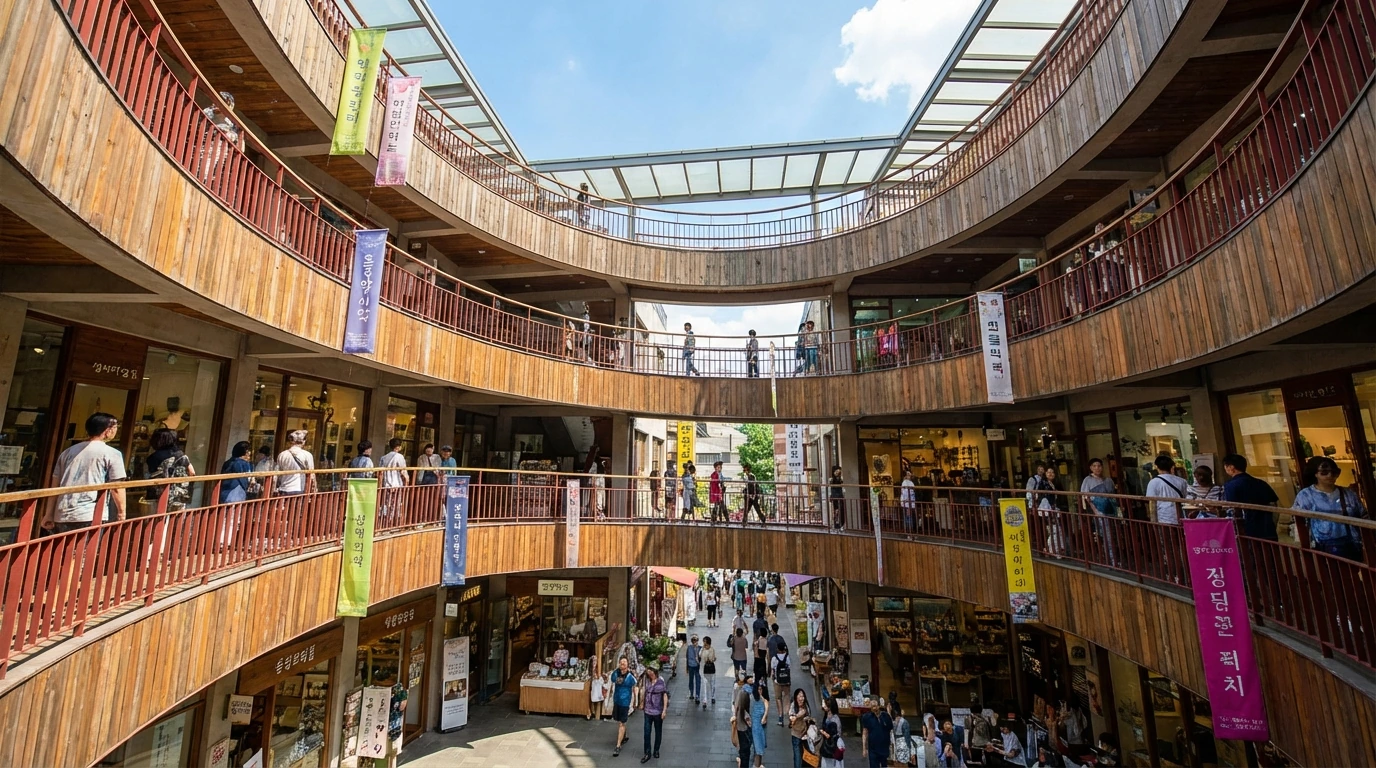
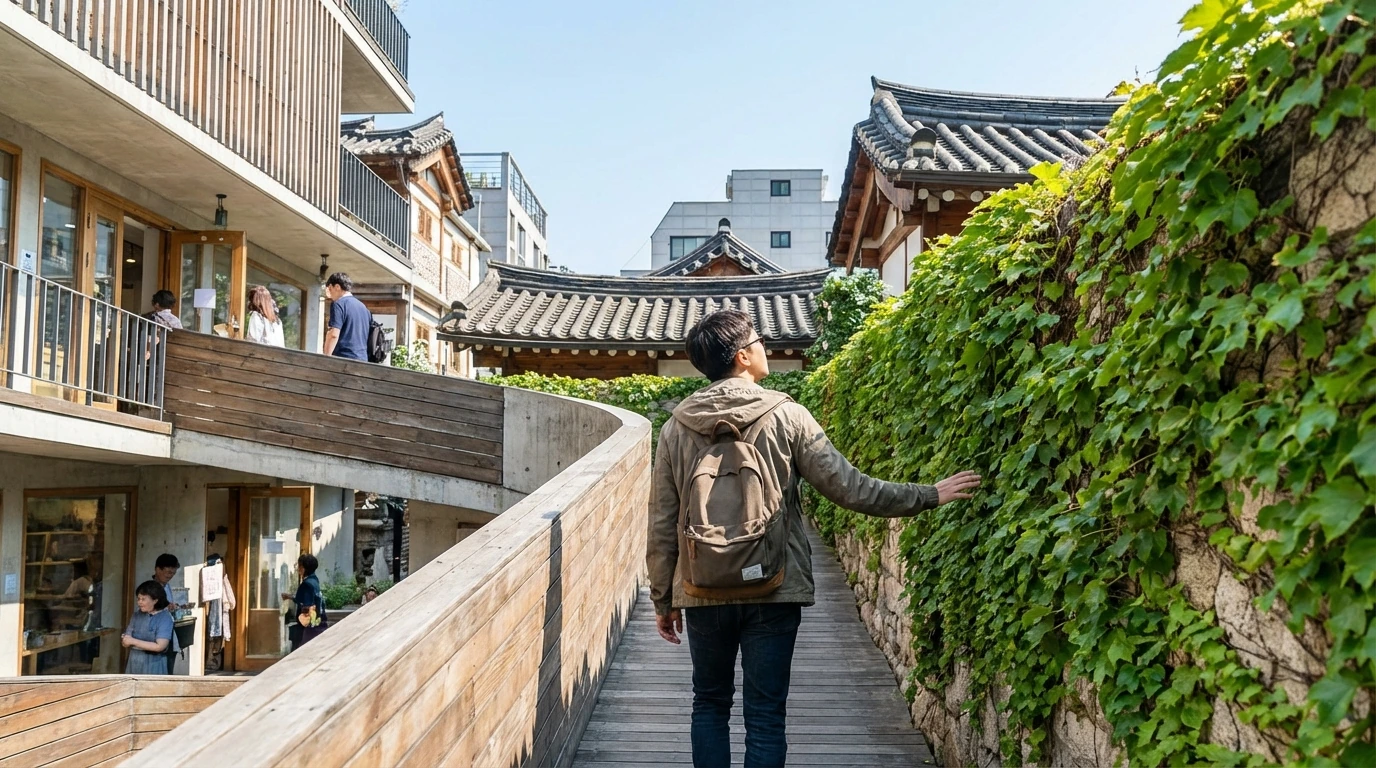
What makes Ssamziegil different is that vertical movement is part of the experience rather than just a way to reach another store. The sloped route keeps connecting one level to the next, so the building reads more like a slow indoor walk than a standard mall. Because of that, the strongest Ssamziegil Insadong photo spots come from transitions between floors rather than from one isolated storefront.
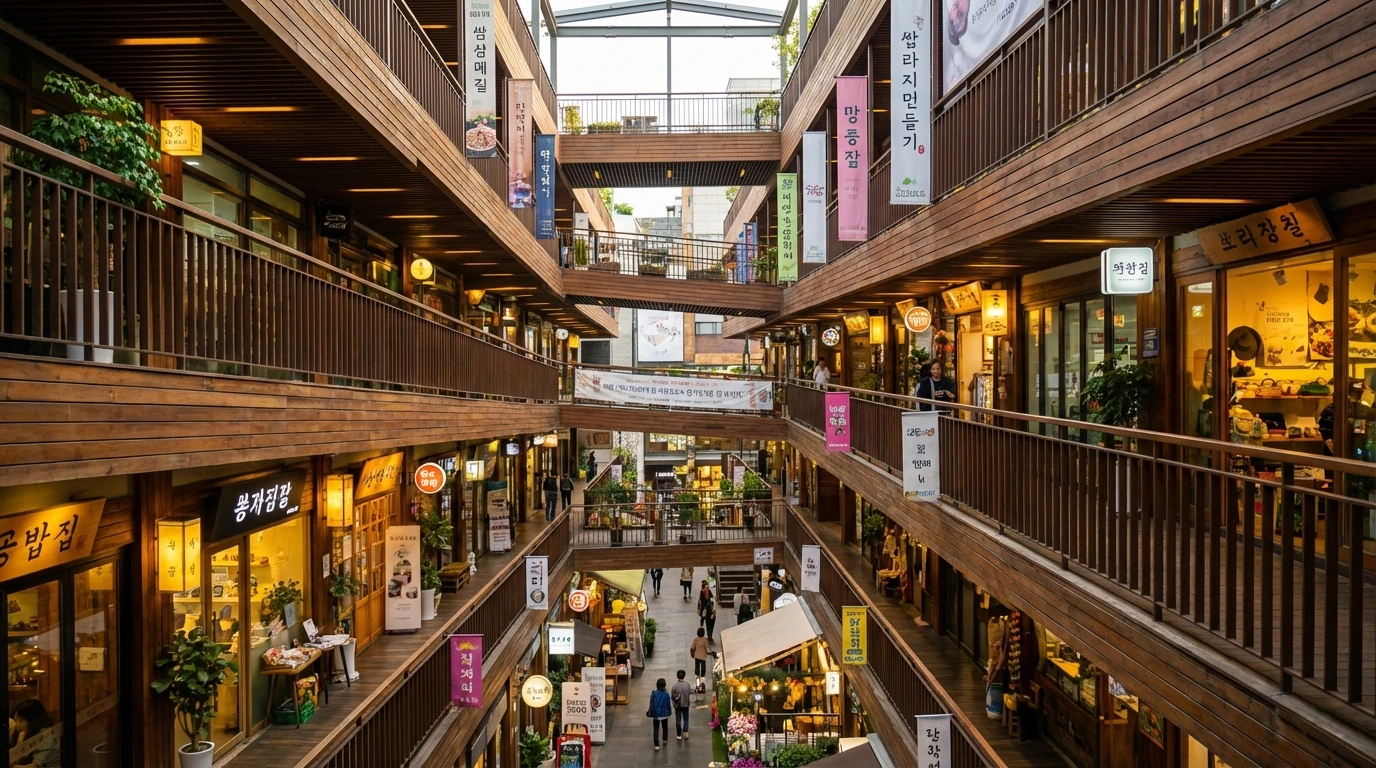
This also changes how the eye moves. You are almost always reading upward, downward, and across at the same time. Railings, signs, small shop fronts, and people in motion keep overlapping, which gives the building a layered rhythm that fits Insadong better than a flat single-level retail space would.
For a first visit, allow 30 to 45 minutes if Ssamziegil is one stop inside a broader Insadong walk. That is enough time to enter slowly, make one full upward pass, pause at a railing, and return without turning the building into a rushed checklist. The building is compact, but the photos improve when you let each level explain the next.
First floor and entry slope decisions
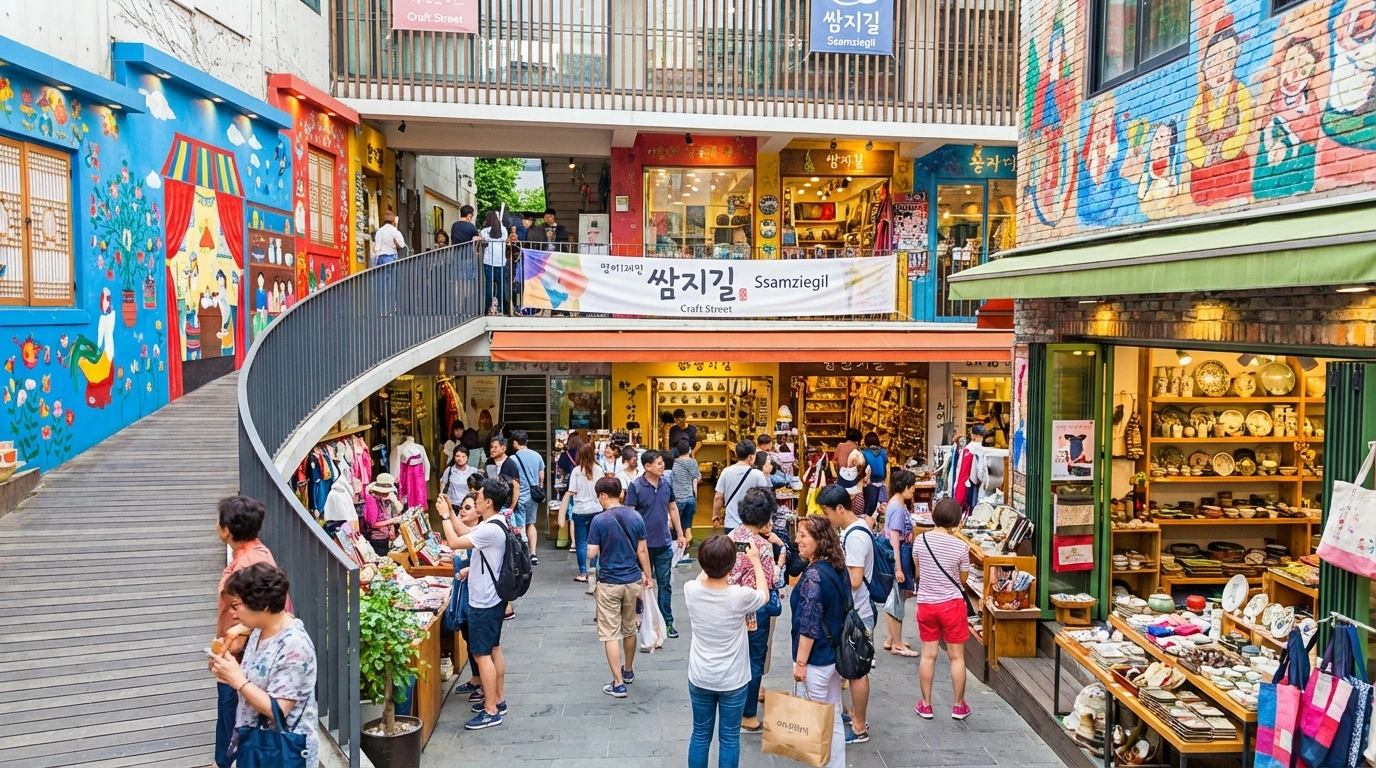
The opening section matters because it introduces the logic of the whole building. On the first floor, signs, displays, and the first rising path sit close together, so visitors can understand the structure quickly. Use a slightly angled frame rather than a direct front view so the photo shows both the entrance pressure and the beginning of the upward flow.
This area is useful precisely because it is not yet too visually complicated. If you shoot too tightly, it can resemble any indoor shopping zone. If you leave enough space for the first slope, people movement, and the first shopfront layers to sit together, the frame starts to explain why Ssamziegil feels different.
At the entrance, step back before photographing signs or displays. A 2- to 3-meter distance can keep the slope, shopfronts, and passing visitors in one frame. If you start with close-ups, the building loses its open-air courtyard identity and becomes a generic retail detail.
The entry slope is also where crowd direction becomes visible. When people are moving in one direction, use them as a diagonal line. When the space is too packed, wait until the first gap appears rather than trying to crop every person out.
Upper floors and stronger layered photos
As you move higher, the structure becomes easier to read. You begin to see downward sightlines, repeating signs, and multiple levels stacking into the same composition. That is why some of the strongest Ssamziegil Insadong photo guide moments happen not at the bottom, but from the middle and upper sections where the building reveals its own geometry.
Those levels make it easier to show what Ssamziegil really is. The charm does not come from one dramatic facade. It comes from small shops accumulating along a connected path. A frame that shows more than one level at once communicates that much faster than a close-up of one corner shop.
The middle and upper levels also reduce the feeling of crowd pressure. From above, people become part of the building's scale instead of blocking the whole subject. A mid-level frame that includes 2 or 3 floors can explain the space quickly, while a bottom-level frame may only show a busy passage.
Use the upper view to compare directions. One side may show more signs and activity, while another gives cleaner geometry. Ssamziegil rewards that small comparison because the building changes a lot with only a few steps.
Railings and interior overlooks as framing tools
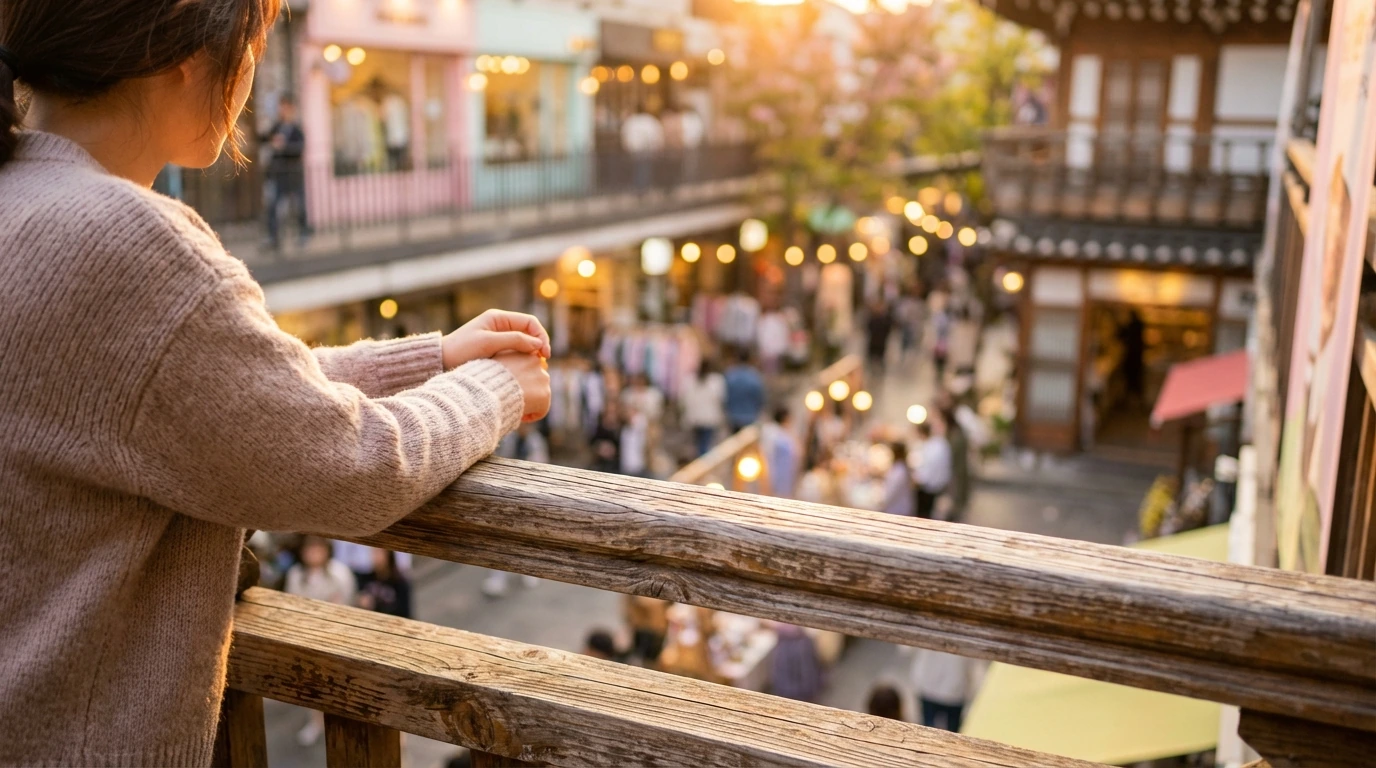
Railings are one of the most reliable framing devices in Ssamziegil. They are not only functional edges. They also help define where the eye should pause before moving deeper into the layered view below. For portraits and spatial shots alike, a railing in the foreground can help the building feel three-dimensional without making the frame too busy.
The key is restraint. If you try to include every visible floor, the image can turn noisy very quickly. If you choose one direction and let two or three levels overlap in a controlled way, the view becomes much clearer. That is the point where Ssamziegil starts to look like a real indoor photo spot rather than just a crowded retail passage.
For portraits, keep the railing as a frame, not a barrier. Place the person slightly away from the rail so the foreground line does not cut through the body. For spatial photos, let the rail occupy one lower corner and use the courtyard depth to pull the eye inward.
The most common mistake is standing directly against the railing and shooting straight down. That angle can flatten the building into a busy floor pattern. A slight side angle keeps the levels readable and makes the slope feel continuous.
Crowd density inside Ssamziegil
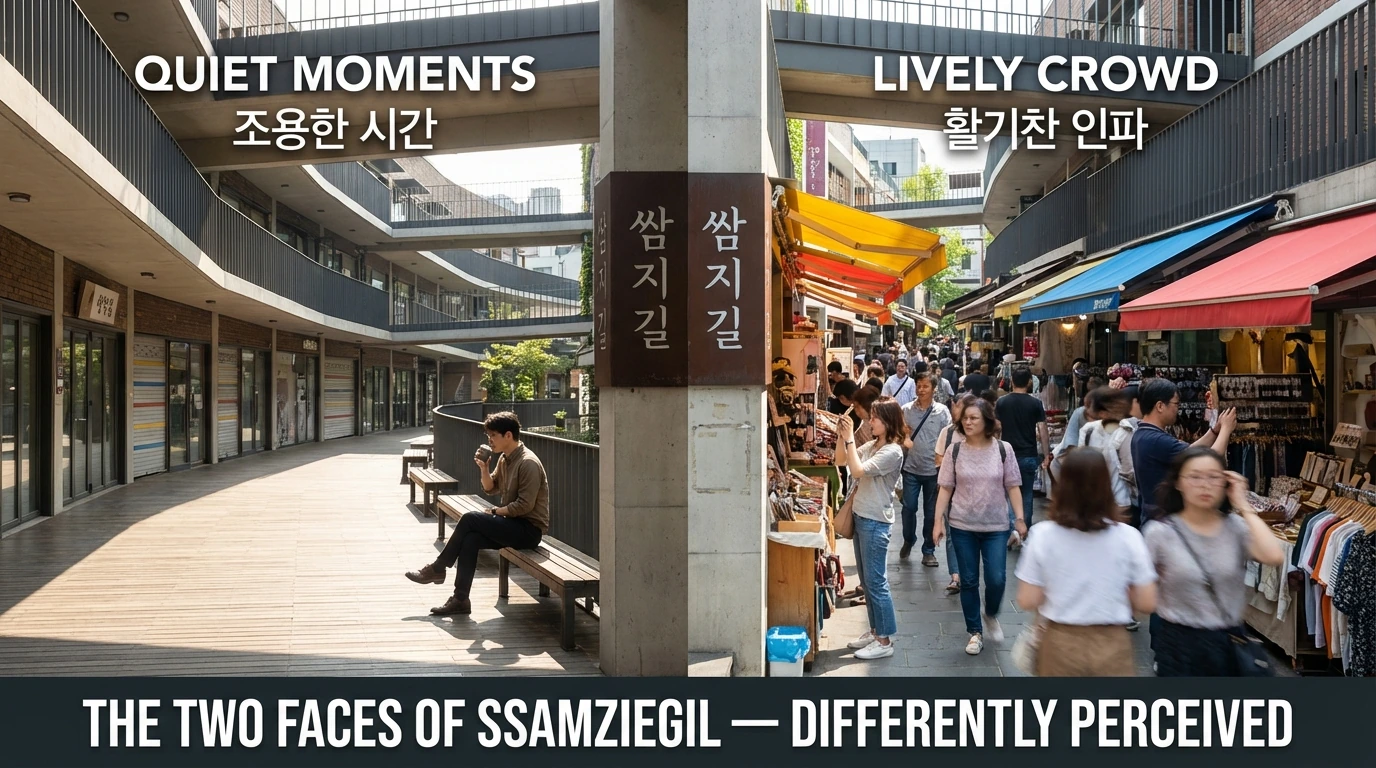
When Ssamziegil is quiet, structure and detail become its strengths. You can read railings, slope lines, displays, and small transitions more cleanly. When it is moderately busy, movement helps the building feel alive and reinforces its slow-walk identity. But if it becomes too crowded, the structure can disappear behind bodies and shopping bags.
That is why timing matters. First-time visitors do better when the space is active but not packed. In Ssamziegil, the architecture is part of the subject. If the crowd hides too much of that architecture, the building loses the quality that makes it visually distinct in the first place.
Late morning and mid-afternoon can feel different even when the building is equally open. Around busier shopping hours, railings and entry areas fill quickly, but upper-level pauses can still work. If you only need 1 or 2 clean photos, head upward first instead of waiting at the entrance.
Moderate crowd is not always a problem. Ssamziegil looks alive when people show how the slope works. The issue is crowd density that hides railings, floor edges, and the open center. If those structural lines disappear, move to a higher angle or wait for a gap.
Floor-by-floor route for first-time visitors
For a first visit, the most efficient route is to enter slowly, read the opening slope, stop around a mid-level railing, and then use an upper-floor overlook before walking back down. That sequence lets you understand the beginning, the transition, and the layered center of the building without overcomplicating the visit. It is better to follow the building's continuity than to treat each floor as a separate stop.
That route gains more context when paired with Best Photo Spots in Insadong for Traditional Seoul Shots. The street guide explains Insadong through alleys and storefront texture. Ssamziegil then adds an indoor version of that slower traditional rhythm, but in a more vertical and structured form.
The practical route is simple: entry slope for context, mid-level railing for depth, upper overlook for geometry, then a slower walk back down for detail. Do not try to photograph every floor equally. Choose one context shot, one layered interior shot, and one detail or portrait. That gives the building a clearer story than 10 similar hallway photos.
Ssamziegil photographs best when you show floor transitions, layered views, and the building's vertical flow.
Mid-level and upper-level railings are the strongest places to frame multiple floors clearly.
An entry-to-mid-level-to-overlook route gives first-time visitors the clearest read on how Ssamziegil works visually.