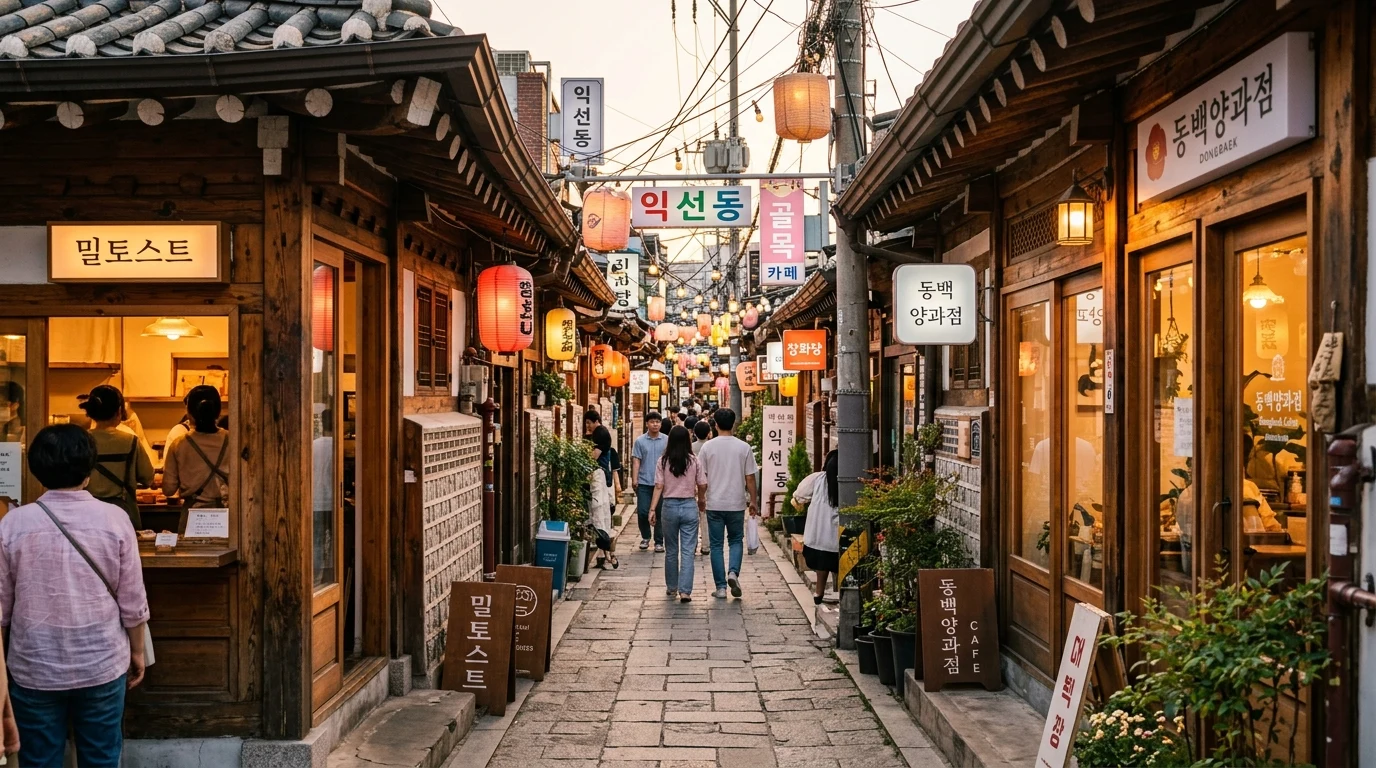
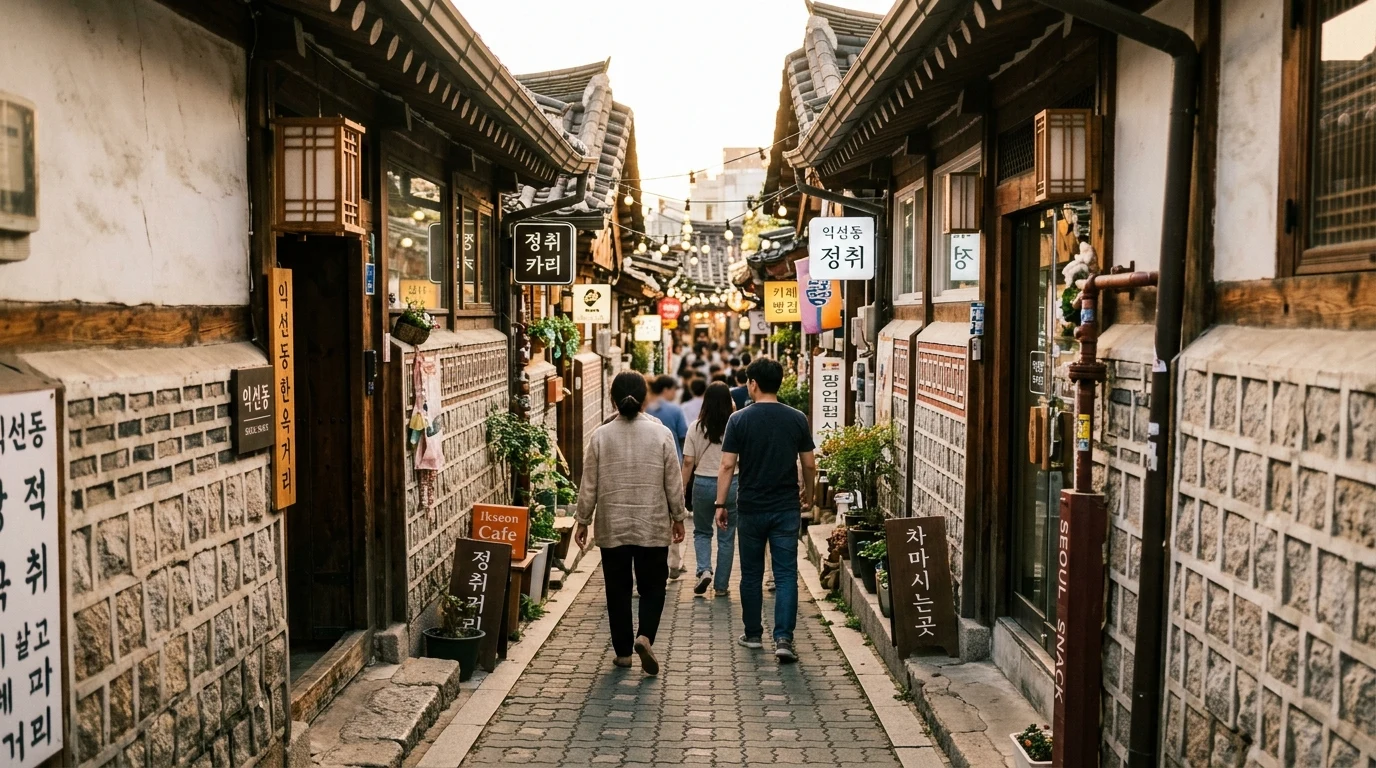
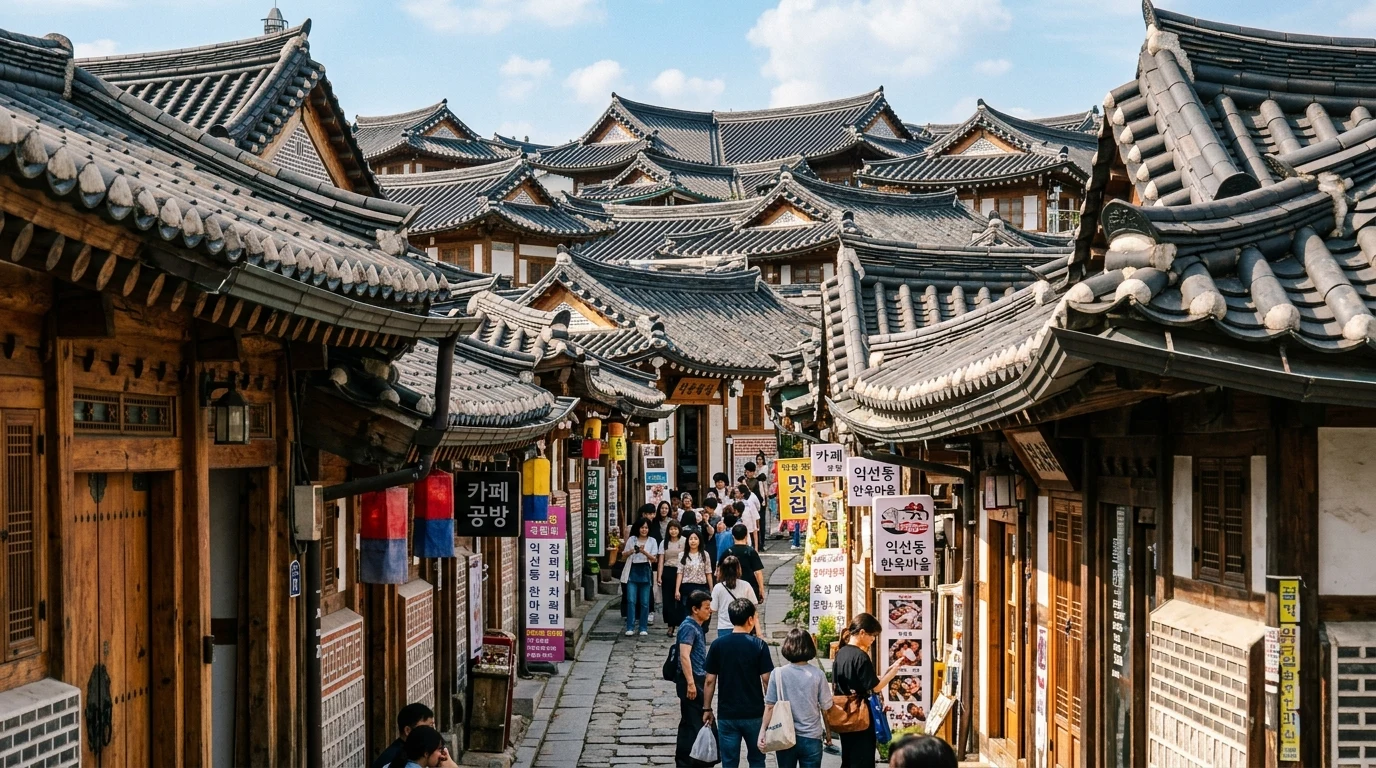
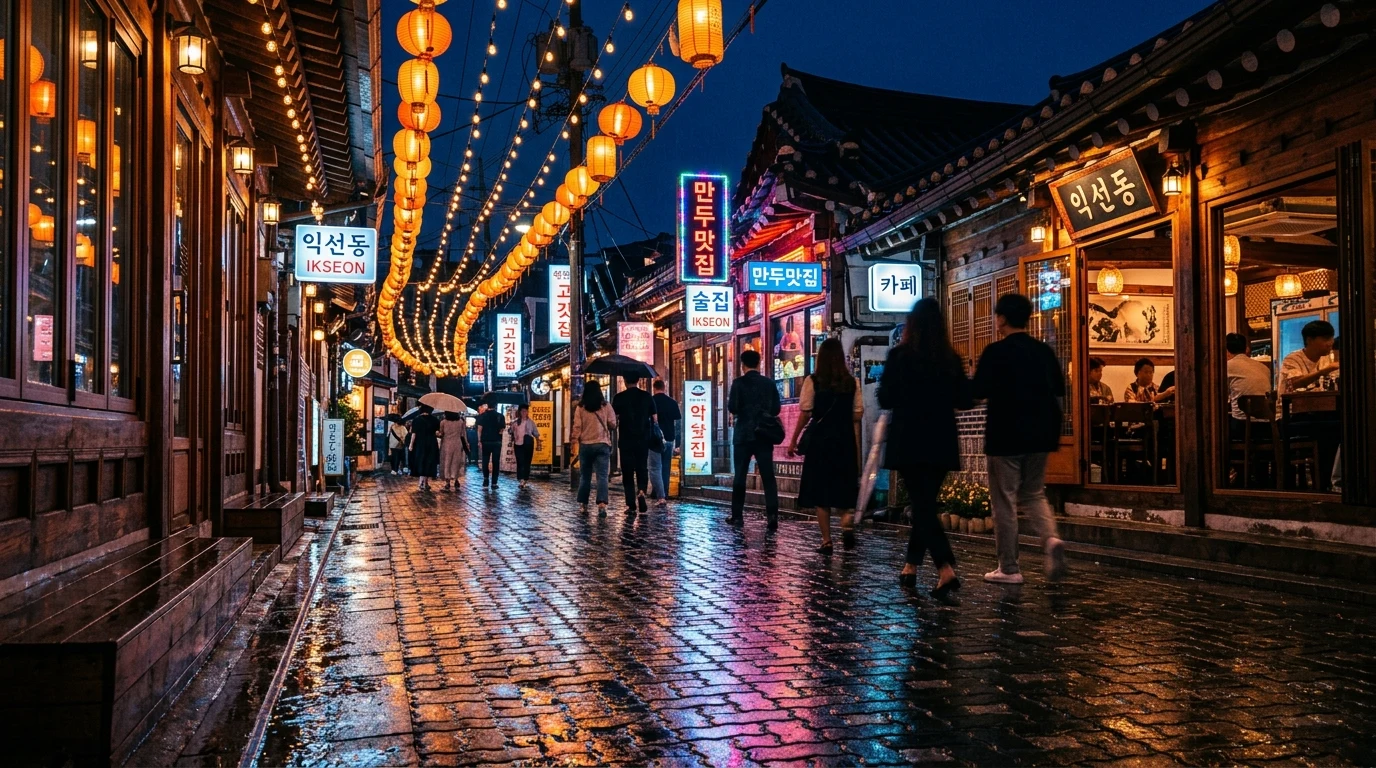
Ikseon-dong is a commercial hanok district, tighter, more cafe-driven, and more visually compressed than quieter neighborhoods. From the moment visitors enter from Jongno 3-ga, the alleys change quickly through storefronts, signs, lighting, walls, and short turns. This guide uses the wider Seoul Photo Spot Guide as a base and explains how to photograph Ikseon-dong in a way that preserves its denser hanok-cafe mood.
Its appeal comes less from one open traditional view and more from constant overlap. Wood, light, windows, signs, people, and short turns keep stacking into each other. That means the district rewards visitors who read small changes well rather than those who only search for one famous frame.
For first-time visitors, that can actually be good news. Once you stop expecting a wide hanok panorama, Ikseon-dong becomes easier to understand. It is a route of compressed scenes, not a route of isolated landmarks.
— Where should you start if you want the clearest Ikseon-dong alley photos
- Best starting logic: begin from the Jongno 3-ga side and read the alley density before going deeper.
- Best for: cafe-heavy hanok photos, narrow alley mood, evening strolls, and compressed neighborhood scenes.
- Best route tip: alternate between the main alley and smaller inner turns instead of going straight to the tightest section.
- Best timing: late afternoon and early night usually show the strongest mood contrast.
Ikseon-dong gets easier once visitors understand its density first. Starting from the Jongno 3-ga side helps because the district tightens gradually instead of all at once, so the alley logic stays easier to read.
That approach also helps with orientation. The outer edge still holds some broader city rhythm, so visitors can feel when the district starts tightening around them. If you rush immediately into the deepest lanes, Ikseon-dong can feel repetitive before it feels coherent.
It also makes crowd management easier. If the main alley feels too busy, it is simpler to shift sideways and then return later than to correct the route after going too deep too fast.
— Why does Ikseon-dong feel denser than other hanok photo neighborhoods
Ikseon-dong is not built around long views or wide hanok framing. Its mood comes from short distances, shopfront overlap, small signs, windows, walls, and repeated corner turns. That creates a denser image field than neighborhoods where roofs and walls have more breathing room.
Because of that, Ikseon-dong works less like a calm traditional village and more like a compressed hanok-cafe district. The appeal comes from how quickly one scene changes into the next.
That also means wide frames are not always the strongest choice. Ikseon-dong often looks best when several layers remain inside a compact view: a roofline, a sign, a doorway, a wall edge, and a passing figure. The district feels most like itself when those details stay slightly compressed together.
Season changes the emphasis as well. In warmer months, outdoor seating, queues, and more active foot traffic become part of the alley image. In cooler months, window glow and interior warmth can shape the mood more strongly. The district remains legible in both cases, but the weight of the scene shifts.
— How should you think about cafe photos in Ikseon-dong
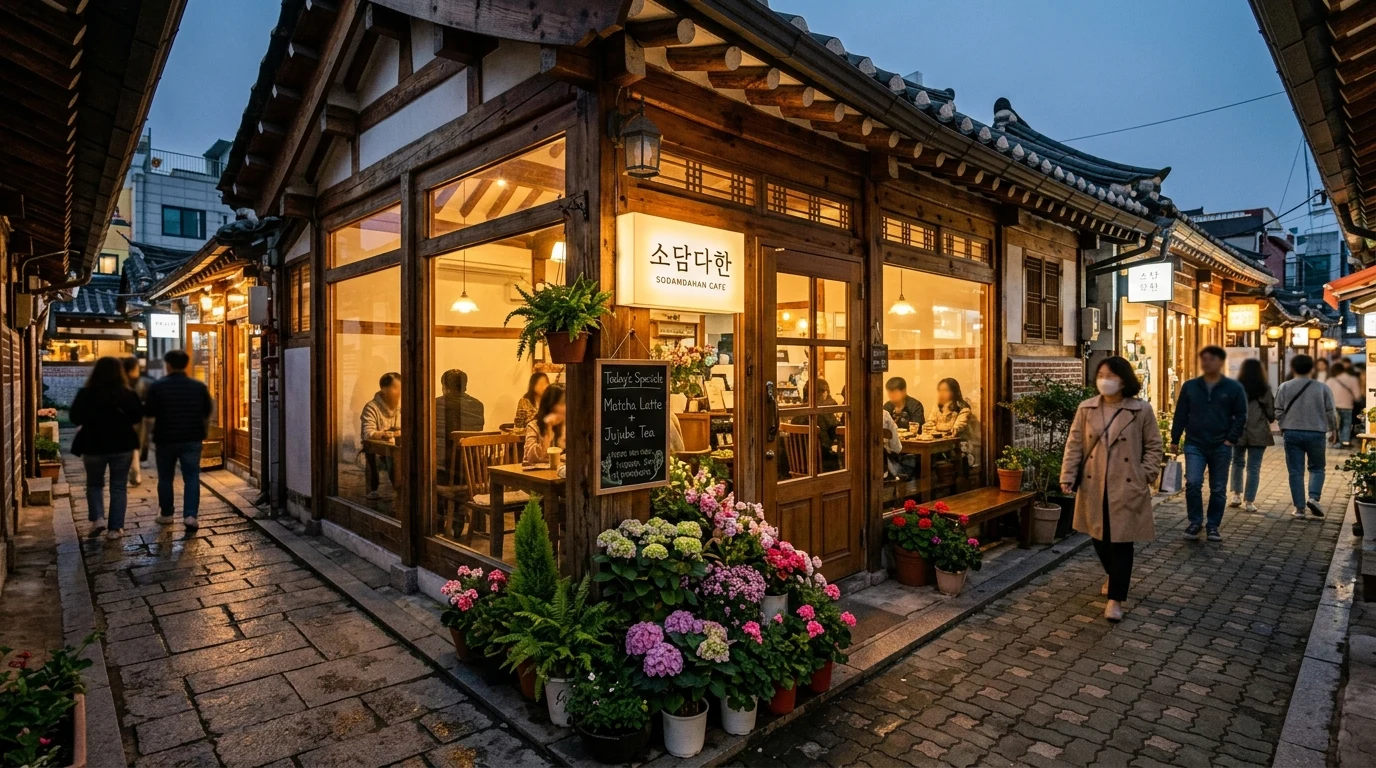
Ikseon-dong cafe photos work best when the shopfront stays connected to the alley. A single storefront can look good, but the district feels most like itself when windows, wood, light, signs, and hanok texture all stay in the frame together.
That is why side angles often work better than front-on views. The goal is not only to show a cafe. It is to show how the cafe sits inside the alley density.
If you want the clearest contrast with a quieter night route, Naksan Park Night View Guide is a strong next read.
If you want to turn that alley mood into something more output-focused after the walk, the K-style profile flow is a natural bridge.
Queue timing is part of that logic too. A popular cafe line does not automatically ruin the route. In Ikseon-dong, doorway light, window reflection, and people waiting can still contribute to the commercial hanok atmosphere. In many cases, the area looks more convincing when the alley remains socially active.
Even indoor images usually work better near thresholds and windows than in a fully isolated corner. Ikseon-dong gains strength when the cafe still feels attached to the alley outside it.
— Why does Ikseon-dong night photography feel stronger than daytime
Ikseon-dong often feels stronger at night because the alleys are already narrow and visually packed. Once interior light, small signs, window reflections, and warm storefront glow turn on, the district becomes more legible through mood than through open form.
That makes Ikseon-dong night photography less about skyline or scale and more about short-range texture. Visitors usually get better results by staying close to alley corners, reflected light, and compressed depth.
The most balanced timing is often the transition into evening rather than full late night. When some sky brightness remains and interior lights begin to glow, Ikseon-dong can show both structure and mood at once. Later hours may feel stronger emotionally, but they can also become busier and harder to control.
That is why waiting for a perfectly empty alley is usually not the best strategy. Ikseon-dong often looks more natural when there is still a little movement left in the frame.
— What is the easiest first-time route through Ikseon-dong
A first-time route usually works best when visitors start from the Jongno 3-ga edge, read the main alley first, move into a denser inner section for the strongest cafe-and-light mood, and then return outward before the scenes start feeling repetitive.
That pattern keeps the district readable. Going too deep too early can make Ikseon-dong feel visually crowded without giving visitors a sense of structure first.
Ikseon-dong works best when visitors let the alley density build in layers.
In practice, a shorter focused loop often works better than a very long wandering session. Ikseon-dong rewards concentration more than endurance. One compact route with a pause and a return angle usually gives more useful photos than trying to cover every narrow lane.
It also helps to revisit one section on the way out. Light direction, crowd rhythm, and reflections can change enough in a short period to make the same spot feel completely different.
— How should crowd level and purpose change your Ikseon-dong plan
Ikseon-dong gets crowded quickly in peak hours, but that does not automatically reduce its value. Queues, passing figures, and close storefront activity are part of what makes the district feel alive. The real question is whether you want that density in the frame. If you want cleaner full-body images, earlier hours and weekdays are usually easier. If you want stronger atmosphere, mild crowd presence can actually help.
Purpose should shape the route from the start. A cafe-focused visit can stay closer to the main alley. A photo-focused walk should use more corners, return angles, and side lanes. A mood-focused evening visit should aim for the period when lights begin turning on instead of waiting only for full darkness. Ikseon-dong becomes much easier once you decide which version of its density you actually want to see.
Ikseon-dong alley photos usually work best when visitors begin from the Jongno 3-ga side and read the district's density gradually.
The strongest Ikseon-dong cafe photos usually keep storefronts, wood texture, signs, and alley space inside one compressed frame.
Night often works better than day in Ikseon-dong because warm light and reflections make the alley mood more legible.