EDITORIAL CHECK
Source and Review Basis
Base-makeup guides prioritize label reading, sun protection, and failure signals by skin condition rather than product claims. Ingredient and function wording is checked against cosmetic-label and dermatology references.
People searching how to choose a cushion foundation are typically trying to solve more than one problem at once. They want a formula that suits their skin type, they want to know whether a semi-matte cushion or a glow cushion makes more sense, and they do not want the base to fall apart a few hours later. This guide breaks down cushion foundation choices by skin behavior, finish, and touch-up practicality so the decision feels less random.
First filters when choosing a cushion foundation
- Start with skin behavior: dry skin typically struggles with lifting, while oily skin typically struggles with movement and shine.
- Then check finish preference: a glow cushion and a semi-matte cushion solve different problems.
- Combination skin frequently needs a cushion that stays balanced across different zones, not one dramatic finish everywhere.
- Wear pattern matters more than first-impression beauty.
- Wear test: check the nose, chin, smile lines, and under-eye area after 3 to 5 hours.
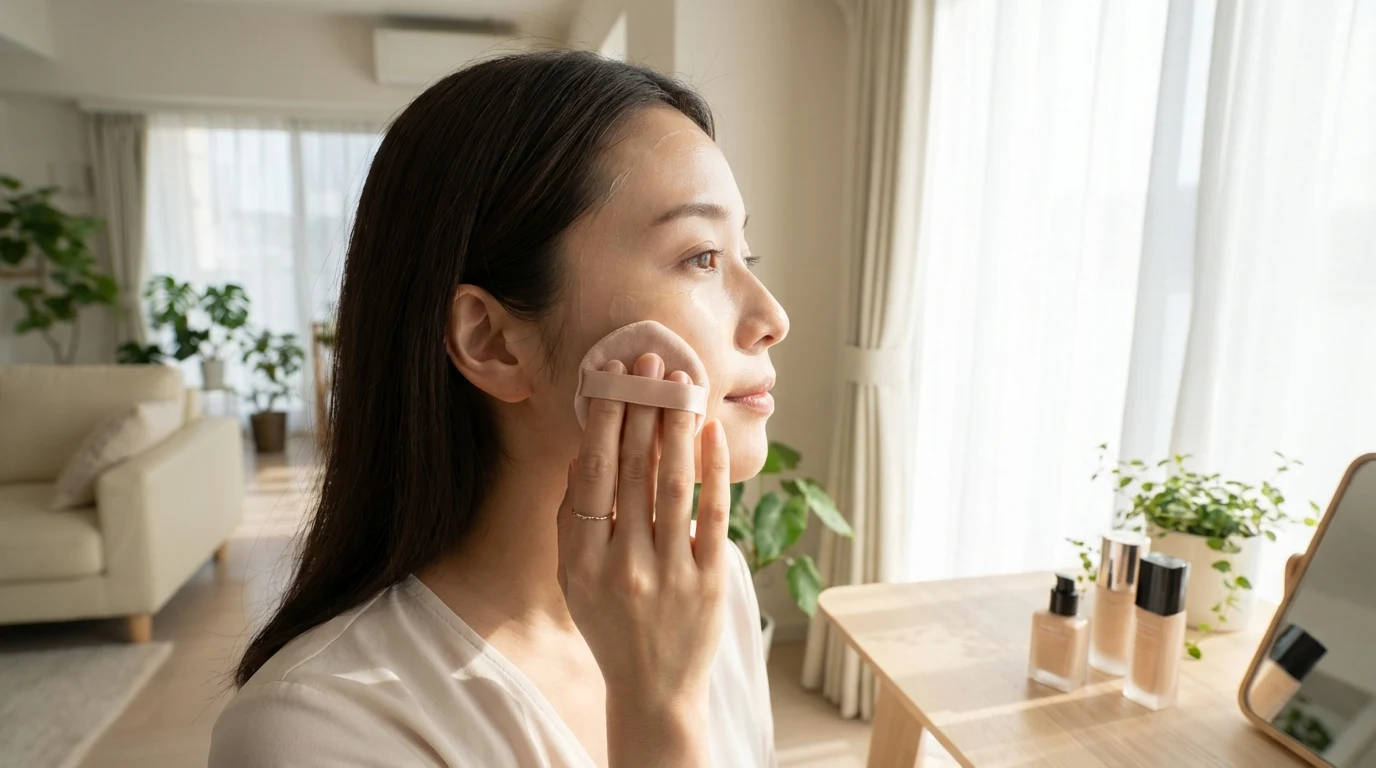
- Puff amount: start with one light press into the sponge, spread it across the center of the face, then reload only for targeted correction.
One of the most common mistakes is choosing by the first swipe alone. A cushion can look polished right away and still break apart around the nose, chin, or under-eye area later. The better question is not whether it looks pretty immediately, but whether it still looks organized after real wear.
If you want the full structure behind that decision first, start with K-Beauty Base Makeup Tips for Smooth Skin That Lasts. This article is the narrower sub-guide focused only on how to choose a cushion foundation well.
Shade testing also needs time. Some cushion formulas darken slightly as they mix with oil or settle over sunscreen. Test the shade near the jaw and check it again after at least 15 minutes if possible. A cushion that looks perfect while wet can become too warm or too gray once the base dries down.
Dry skin does not automatically need the glossiest cushion
Dry skin frequently feels more comfortable in a glow cushion, but that does not mean the wettest-looking formula is always the best choice. If the surface stays too slippery, the base can move more easily across pores, texture, or fine lines. What matters more is whether the cushion keeps the skin comfortable and settled without making dry edges stand out more strongly later.
That is why dry skin should test comfort and stability together. A cushion that looks radiant but shifts too easily may still be less useful than one that looks a little quieter and stays cleaner through the day.
Dry skin should pay attention to the first 20 minutes after application. If the cushion clings around the mouth, nostrils, or between the brows almost immediately, the formula may be too dry or the skincare underneath may need more time to settle. Ingredients such as glycerin, hyaluronic acid, and panthenol in prep can help the surface feel smoother, but a cushion still needs flexibility once facial movement begins.
A glow cushion is most useful when it keeps dry areas comfortable without leaving the entire face wet-looking. If the cheeks look healthy but the nose already slides, use powder only through the center instead of abandoning the formula completely.
Semi-matte cushions for oily and combination skin
For oily or combination skin, a semi-matte cushion frequently feels more practical because it controls movement before the base becomes messy. If oil rises quickly, an overly glossy surface can become harder to manage with every touch-up. A more settled finish typically keeps the nose, chin, and other high-movement zones easier to correct.
That does not mean semi-matte has to feel dry. If the skin already feels tight underneath, a finish that only suppresses shine can crack later. Combination skin typically needs a cushion that keeps the cheeks comfortable while stopping the T-zone from becoming overly reflective.
For oily skin, the key test is not whether shine disappears completely. It is whether shine returns in a way that can be blotted cleanly. If the cushion separates into small patches around the nose after 2 or 3 hours, the formula may be too emollient or the first layer may have been too thick. If it becomes shiny but remains smooth, the cushion is easier to live with.
Combination skin should avoid choosing only for the T-zone. A very dry semi-matte cushion can control the nose while making the cheeks look older or more textured. A better choice is frequently a soft semi-matte or natural finish paired with targeted powder through the center.
Longer wear depends more on layer behavior than coverage
Many people start with coverage claims, but longer wear typically depends more on layer behavior than on maximum correction. A cushion that deposits too much at once may look smooth at first and become harder to reapply later. A cushion that builds in thinner rounds frequently performs better in real life because it gives you more control over touch-ups and thickness.
The useful test is whether tapping the puff helps the base settle or whether each pass leaves more product sitting on top. If your larger goal is a more stable low-breakdown base, K-Beauty Base Makeup Tips for Smooth Skin That Lasts gives the broader structure that makes these product comparisons easier.
If you already know that you prefer a more controlled finish than a dewy one, the next branch from here is Semi-Matte Base Makeup Guide for Balanced Soft Skin. At this stage, though, the main job is still learning whether your cushion stays readable once the skin starts moving.
The first layer should be a map, not the final answer. Tap the cushion through the center of the face, press it in, then wait a moment before adding more. If redness still shows on the cheeks or around the nose, add a second thin pass only there. If you cover the outer face too strongly on the first pass, the cushion can look heavy even when the product itself is not full coverage.
Formula language can help but should not decide everything. Film-forming textures can improve wear, silica can reduce shine, and dimethicone can smooth application, but all of them fail when too much product sits on top of moving skin. Thin buildability is the practical feature to test.
Cushions that survive touch-ups
If you rely on touch-ups during the day, the most useful cushion is typically not the one that looks the fullest on the first pass. It is the one that can be tapped back in without creating hard edges or heavy buildup. Cushion foundation is convenient precisely because it is easy to carry and reapply, so a formula that turns thick quickly can become frustrating in real use.
This is also where technique matters. If your nose or chin tends to break apart by afternoon, managing surface oil before reapplying frequently matters just as much as the cushion itself. The best cushion for touch-ups typically behaves like a refining tool, not like a full restart every time.
The best touch-up cushion has a forgiving edge. When you tap it over older makeup, the new layer should blur into the surrounding base instead of leaving a hard patch. If every touch-up creates a visible circle, the cushion may be too high coverage, too dry, or simply too difficult to blend over itself.
Use a removal-first order for midday correction. Blot oil, press the area with a clean puff, then apply a rice-grain amount of product to the broken section. Reloading the puff fully for a small nose or chin correction is typically too much. The goal is to reconnect the surface, not create a second morning base.
The reliable rule behind choosing a cushion foundation
The best cushion foundation is typically the one that leaves your skin looking least tired after hours, not the one with the loudest finish trend. For dry skin, that frequently means less lifting. For oily skin, it means shine that stays more controlled. For combination skin, it means keeping different zones from fighting each other too visibly. That is why learning how to choose a cushion foundation is really about reading how your skin breaks down over time.
Once that part becomes clearer, you typically need fewer experiments to choose well. From there, narrowing the finish direction, especially toward a semi-matte base, becomes much easier.
The cushion is a good match when the face looks less tired after several hours, not necessarily when the first mirror check looks flawless. Dry skin should look less lifted, oily skin should look easier to blot, and combination skin should look less divided between shiny center and tight cheeks. Those wear signals are more reliable than the finish label alone.
The best way to choose a cushion foundation is to judge how it wears after hours, not just how it looks on the first pass.
Dry skin frequently prefers a glow cushion, while oily and combination skin frequently do better with a semi-matte cushion that controls movement more clearly.
Real-life satisfaction typically depends more on thin buildability and touch-up ease than on headline coverage claims.
💡 Editor's Honest Review
After buying and trying countless products with my own money, I realized you don't need the most expensive items. Finding basic items that fit your skin type or body shape is much more important. I usually stock up during major sales events at Olive Young Global or Musinsa Global.
| Buying Point | Editor's Pick | Pro Tip | |---|---|---| | Value | Value Sets during sale | Best time to stock up! | | Practicality | Daily wear/use items | Basics over trends. | | Trend | Clean and timeless | Make sure it lasts. |