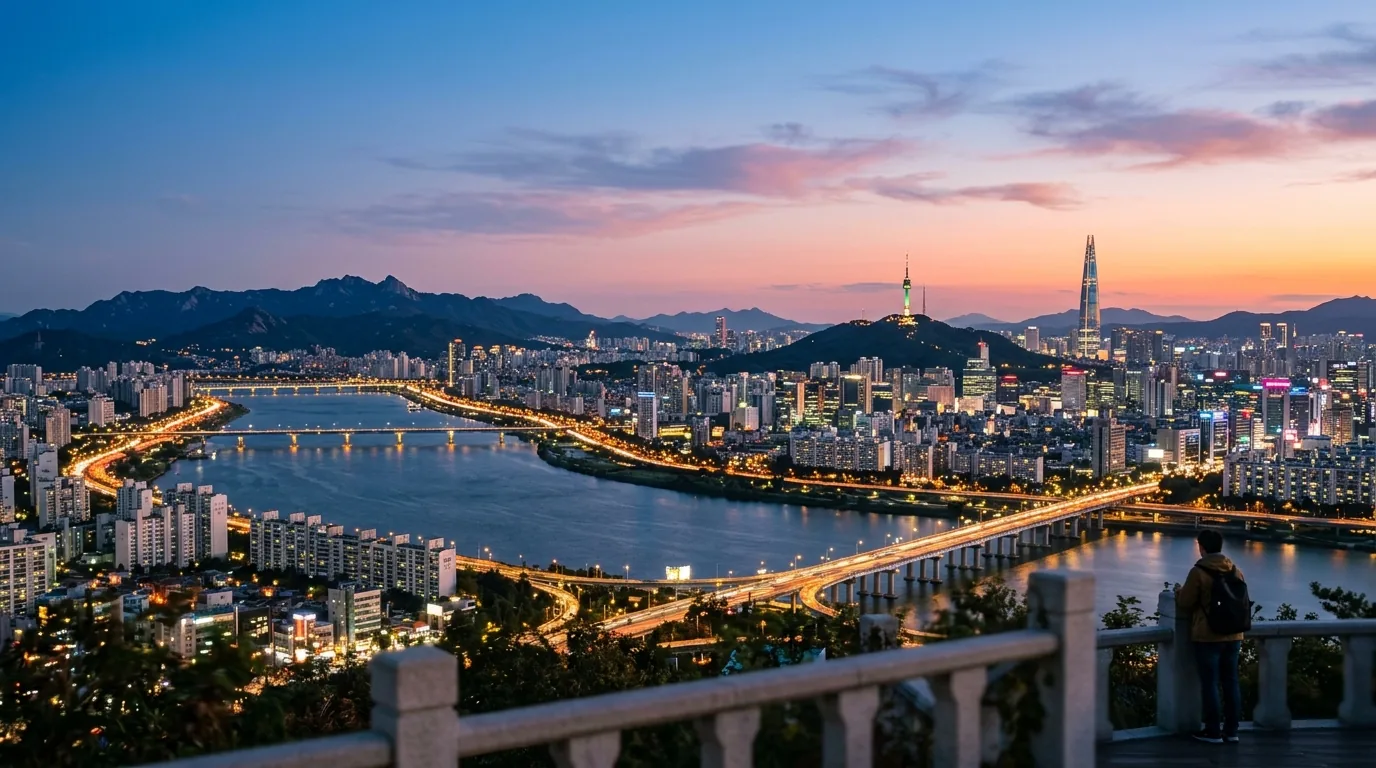
Travelers looking for Namsan cable car photo tips often treat the ride as a quick transfer to the tower, but visually it works more like a compressed introduction to how Seoul rises, opens, and reorganizes itself. International visitors usually remember the cable car as part of the landmark experience, yet the real value is that the city does not appear all at once.
It reveals itself in stages through glass, slope, and elevation. This guide explains when to ride, what to notice from the window, how to frame the moving view, and how to connect the ride with your first skyline shots after arrival.
The short length of the ride can be misleading. Because the ascent is brief, every change in height feels stronger. Trees, hillside texture, and close structure give way quickly to wider city geometry, which makes the route feel almost like a visual edit rather than a simple commute.
That is why it helps to treat the cable car as its own photo sequence. The waiting area, the moving cabin, the first outdoor arrival, and the later skyline viewpoint all belong to the same visual story.
— Why the Ascent Matters More Than the Destination
Verified date: 2026-10-11. Facility and transit details may change depending on operating authorities.
| Item | Details | | :--- | :--- | | Public Transit | Myeongdong Station (Line 4) Exits 3 & 4 (approx. 10 min walk; Namsan Ormi inclined elevator available from Exit 4) | | Operating Hours | 10:00 – 23:00 daily (subject to suspension during severe winds or inclement weather) | | Ticket Rates | Round-trip: Adult 15,000 KRW / Child 11,500 KRW (One-way: Adult 12,000 KRW / Child 9,000 KRW) | | Parking & Shuttle | Limited on-site parking (paid) / Free shuttle bus from Myeongdong Station Exit 1 |
- How to get there: A 5 to 10-minute walk from the nearest subway station exit.
- Best time to visit: Between 2:00 PM and 4:00 PM for optimal natural lighting.
- Estimated duration: 1 to 2.5 hours depending on crowds.
- Budget & Tips: Expect to spend around 15,000 KRW per person on average.
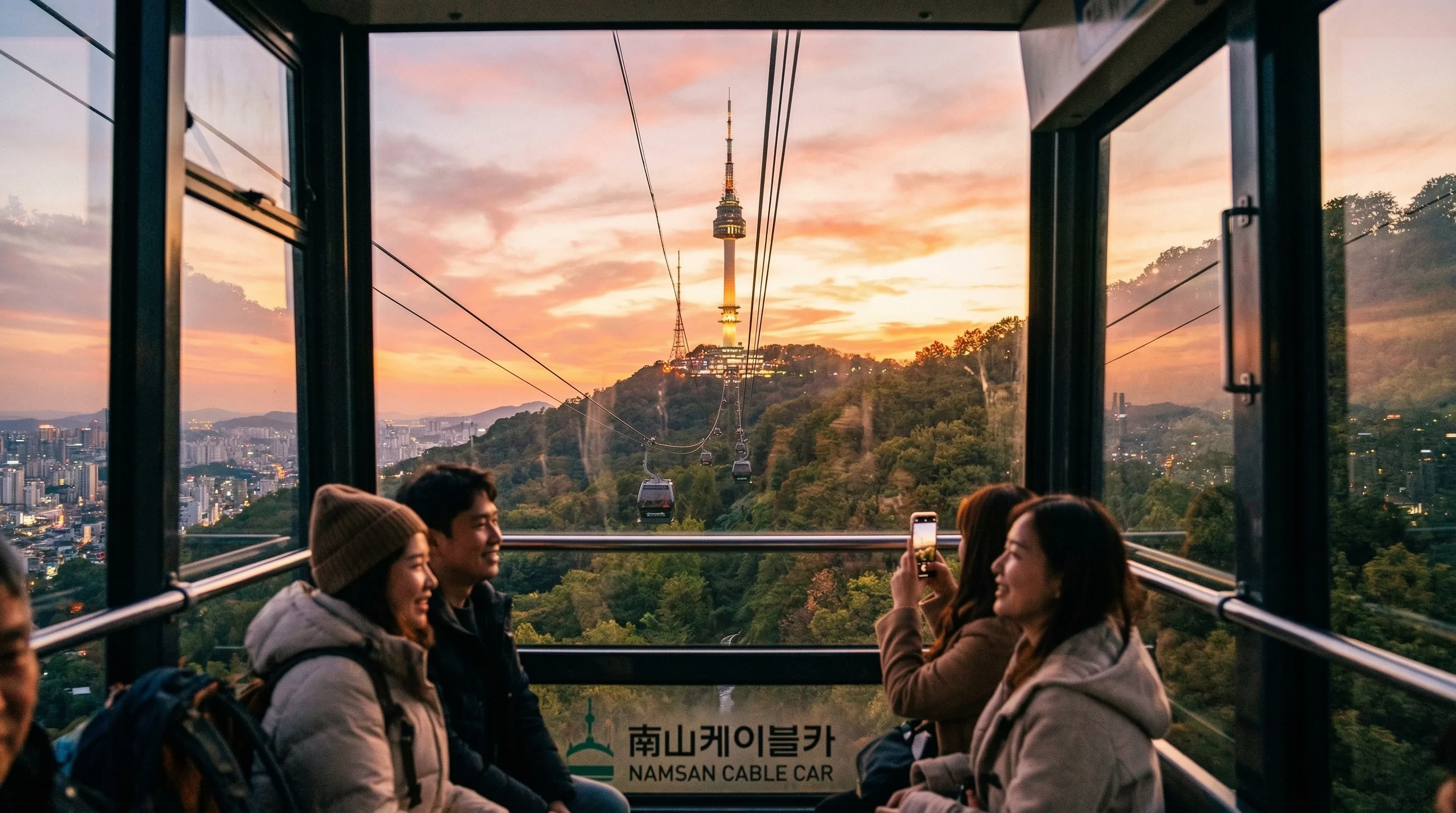
The strongest part of the cable car experience is the transition itself. At first, the frame is filled by slope, trees, and near-ground structure. Then the city begins to open behind them, and within moments the ride shifts from enclosed movement to suspended overlook. That rapid change is what gives the cable car its visual identity.
This is also why the ride produces a different kind of image from a static observatory. Even a simple portrait gains context because the city is not just sitting behind the subject as a flat backdrop. It is arriving in layers. Good Namsan cable car photo tips start from that idea: the ride is valuable because it records Seoul becoming visible.
It also changes what counts as a successful frame. Instead of trying to capture the whole skyline at once, it often works better to notice how near and far elements trade places as the car rises. That layered transition is what separates the cable car from the viewpoints above it.
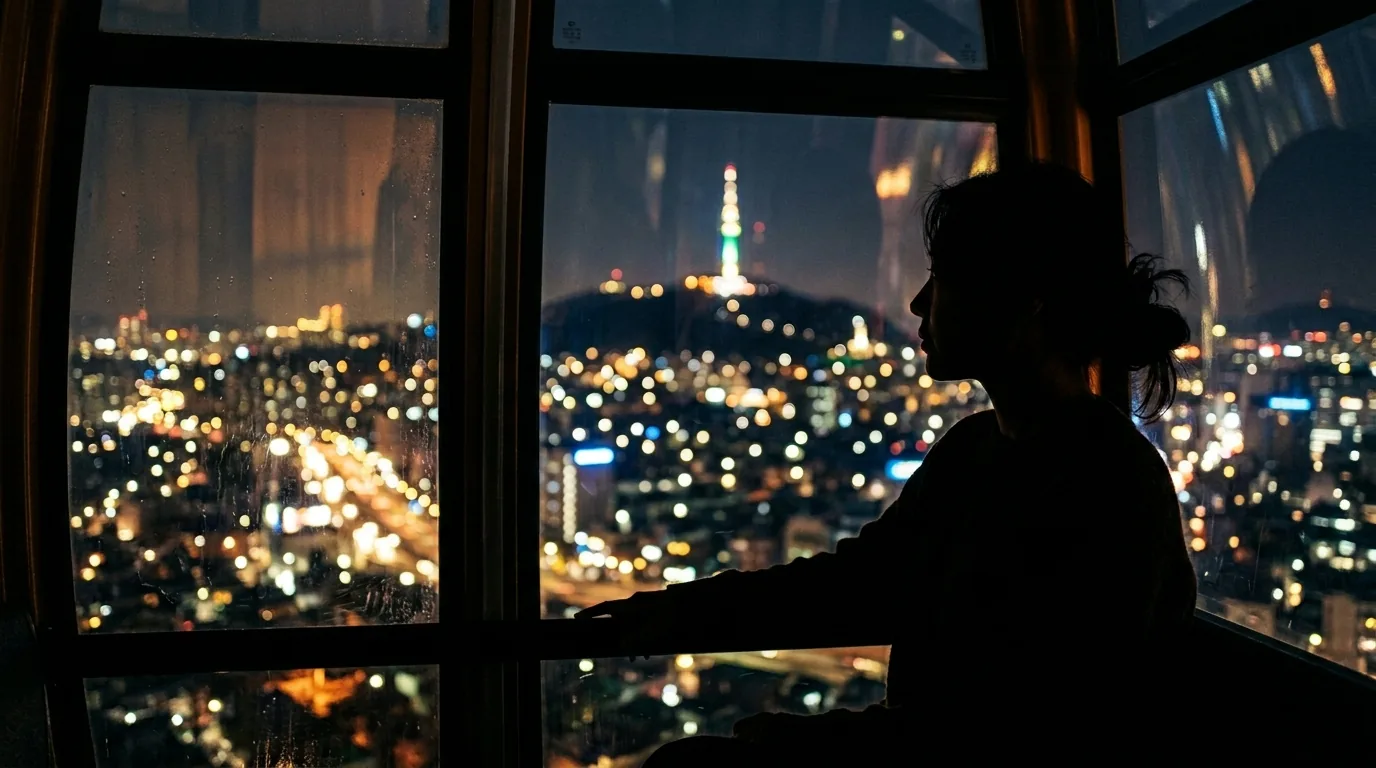
Portraits benefit from that as well. Side profiles, hands near the window, and the feeling of looking outward usually suit the ride better than a fully static front-facing pose.
— When the Window View Explains Seoul Most Clearly
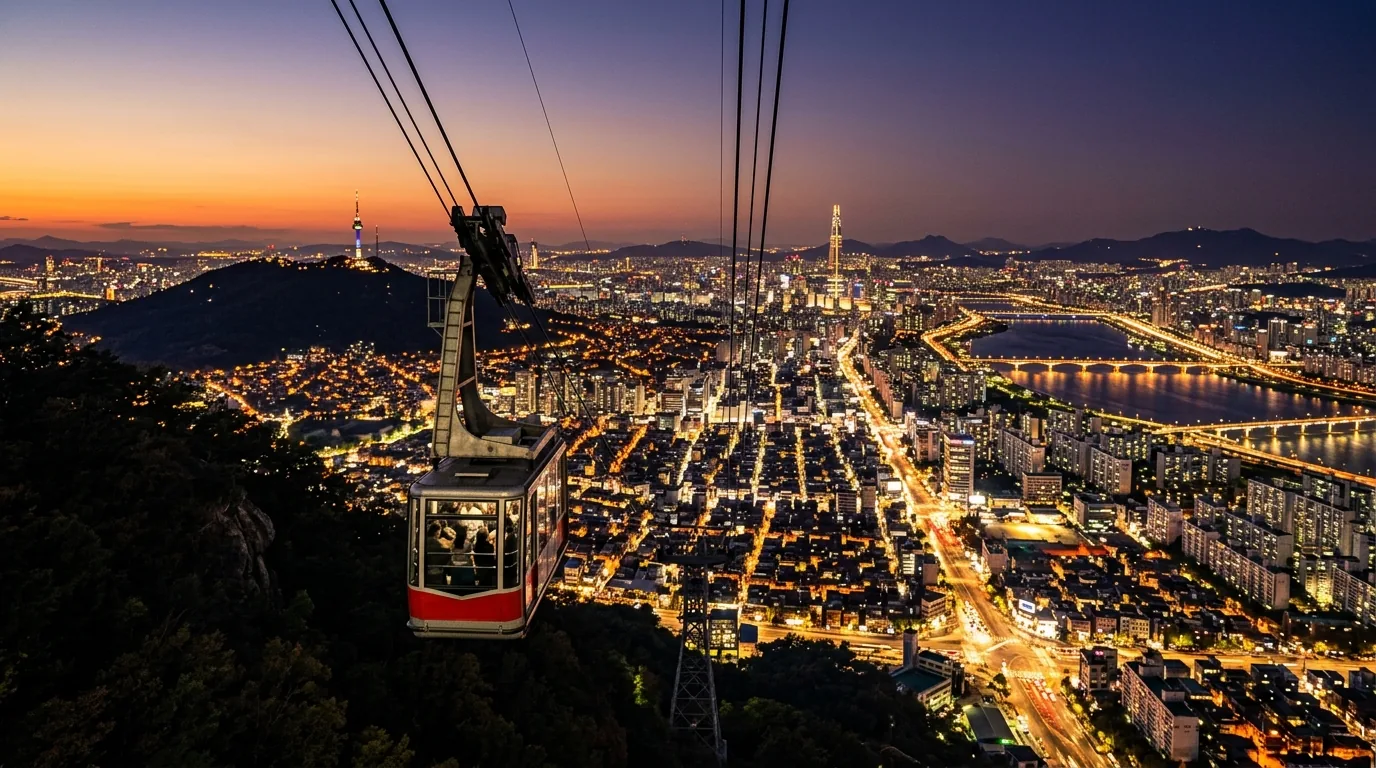
The best moment is usually not full darkness. If you board while some blue tone still remains in the sky, the slope of Namsan, the outline of the city, and the first strong light bands can all stay visible together. That gives the scene more structure and depth. Later at night, the lights can become more dramatic but the terrain becomes harder to read.
For many visitors, early evening creates the most balanced result. The city already feels like a night destination, but the view still contains enough shape to explain where Seoul sits and how the districts spread outward. If your goal is clarity rather than pure glow, catch the transition instead of waiting for the darkest hour.
Season changes the ideal timing slightly. Summer can stay bright longer than expected, which may delay the most useful moment. Winter shortens the blue-hour window but often gives clearer air. Spring and autumn are usually the easiest for first-time visitors because city outline and atmosphere stay balanced for longer.
Crowd level matters too. On busy evenings, long waits can cause you to miss the exact light you wanted. Arriving a little earlier than the ideal boarding time often works better than trying to time the queue perfectly at the last minute.
— What to Use as a Visual Anchor Inside the Car
Because the ride is always moving, trying to capture everything at once usually weakens the image. It helps to choose one anchor first. That might be the window frame, the silhouette of the person beside you, or one bright axis in the city below. Once the frame has a stable reference, the surrounding movement starts to feel intentional rather than messy.
The same applies to portraits. Instead of chasing a fully lit face, it often works better to let the profile, hand position, or glance toward the city carry the mood. Cable car images tend to work best when they accept motion and partial framing. The more honestly the photo reflects the in-between nature of the ride, the stronger it usually feels.
If you can choose your position, it usually helps not to press directly against the glass. A little distance can reduce the dominance of reflections and make the frame easier to stabilize. Including part of the window edge or cabin structure can also help the image feel intentional.
For phone photography, the widest lens is not always the best choice. Wider views show more of the city, but they can also amplify glass distortion and interior reflections. A slightly tighter framing often produces a cleaner result.
— How to Extend the Ride Into a Stronger Photo Sequence
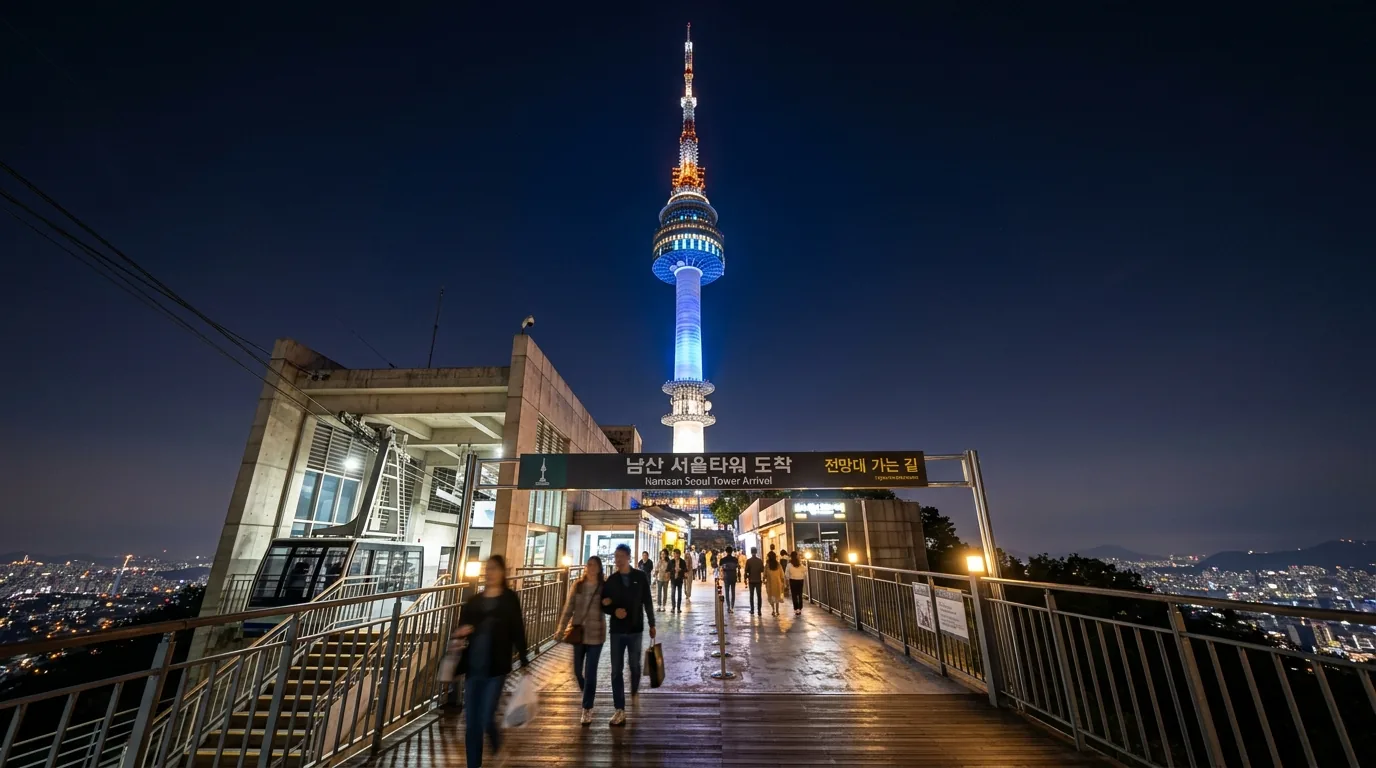
The cable car experience becomes more complete if the visual story does not stop when the doors open. After arriving, it usually works better to pause outdoors first rather than rushing immediately into the observatory interior. That first open-air moment shows how the compressed window view expands into a broader city panorama.
This helps sequence your images as well. A close interior frame from the ride, a transitional shot right after stepping out, and then a wider skyline scene create a much better visual record than unrelated single images. In that sense, the cable car is not just transportation. It is the opening chapter of the tower visit.
It usually helps to pause outside first rather than running indoors. That first moment of open air is where the compressed cabin view expands into a full city panorama, and the contrast between those two states is one of the strongest parts of the experience.
Keeping that sequence in mind also makes the later skyline photos stronger. They stop feeling like random tower shots and start feeling like the conclusion of the ascent.
— How Namsan Cable Car Differs From Other Moving Night Routes
Night drives through the city emphasize horizontal speed, reflections, and passing commercial surfaces. The Namsan cable car does something else. It emphasizes vertical movement. Instead of showing Seoul rushing past, it shows Seoul unfolding below. That difference changes the emotional reading of the ride.
Because of that, Namsan cable car photo tips are useful even for visitors who are not trying to create polished travel photography. The ride offers one of the quickest ways to feel Seoul change scale in real time. For first-time visitors, that makes the skyline easier to understand. For repeat visitors, it can make a familiar city feel newly legible again.
Compared with other Seoul night routes, the cable car is also easier to manage physically. It does not require a long riverside walk or the speed of a city drive, yet it still delivers a strong sense of the city changing shape. That makes it especially useful for visitors who want a memorable Seoul night sequence without a complicated route.
It also works well as part of a date itinerary because the ride, the arrival, and the later tower area naturally build on one another. The visual structure and the emotional structure line up unusually well.
— What route should first-time visitors follow for the cleanest Namsan cable car photo sequence
For a first visit, it helps to decide the sequence in advance. Use the waiting time to read the sky and city brightness, board with one visual anchor in mind, then pause in the semi-open arrival zone before moving to wider viewpoints. That creates a clean three-part sequence: ascent, arrival, expansion.
Energy management matters too. The cable car itself is short, but the outing often continues into the tower and surrounding decks. It is usually better to let the ride produce the compressed intimate frames and save broader city compositions for after arrival. Namsan cable car photography works best when the ride is treated as the beginning of the skyline experience, not as the whole experience by itself.
The ride works best visually when you treat it as a staged ascent rather than a simple transfer to the tower.
Early evening usually gives the clearest combination of sky tone, terrain outline, and city lighting.
The strongest image sequence links the ride interior, the first outdoor arrival, and the wider skyline beyond.