EDITORIAL CHECK
Source and Review Basis
Hongdae guides are checked against Seoul tourism and city street references for Red Road, walking flow, performances, nightlife, and time-of-day differences.
People searching for the best Hongdae street photo spots frequently expect a short list of murals or one famous main strip. In practice, Hongdae works differently. The district is photogenic because busking stages, storefront light, side alleys, and shifting crowd density keep changing the frame every few minutes. Building on the street logic explained in Hongdae Seoul Neighborhood Guide, this guide shows where Hongdae looks most convincing, what each zone does visually, and how timing changes the result.
That means Hongdae is less about fixed landmarks than about changing conditions. The same corner can feel generic one moment and distinctly Hongdae a few minutes later once queue lines, busking, light spill, and passing movement line up correctly. Learning to read those changes is more useful than memorizing one famous wall.
This is especially helpful for first-time visitors, because Hongdae can otherwise flatten into a simple busy district. Once you notice where density increases, where rhythm breaks, and where narrow lanes reset the mood, the area starts to become much more legible on camera.
— Where to Start if You Want the Best Hongdae Street Photo Spots
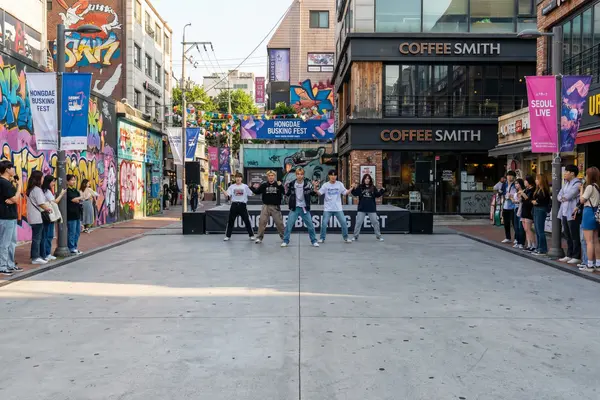
The first area to read is the main pedestrian flow where Hongdae feels most compressed. This is not mainly about one landmark. It is about how signage, storefront fronts, queue lines, and crossing foot traffic stack into a single frame. If you shoot too wide, it can flatten into a generic busy district. If you tighten the frame around movement and overlap, the area starts to look recognizably Hongdae.
This main route also helps first-time visitors understand the district quickly. A slightly angled composition typically works better than a straight-on one because it shows how people move across rather than directly toward you. That crossing motion is one of the clearest signs that Hongdae is a street environment built around drift as much as destination.
Time of day changes how this route behaves. Late afternoon typically makes storefront structure easier to read, while evening pushes the district's speed and brightness forward. For many visitors, the clearest strategy is to understand the street in late afternoon and then stay long enough to see what the first wave of stronger lighting does to the frame.
That also explains why diagonal framing works so well here. It lets signs, queues, and crossing pedestrians build visible pressure together instead of flattening into a wide anonymous street.
— Why Busking Zones Feel More Distinctly Hongdae
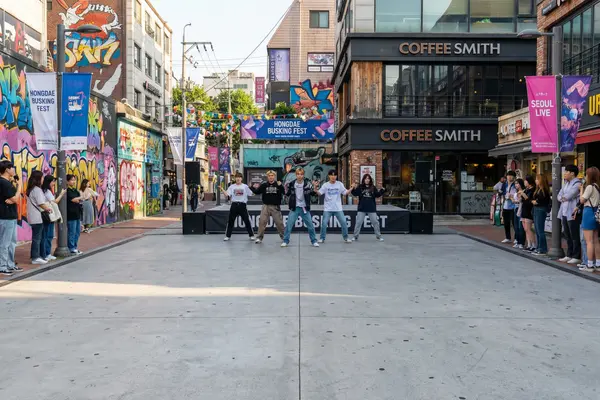
Busking areas are where Hongdae separates itself from cleaner commercial districts. Around street performances, watchers, passersby, and people stopping for a few seconds create visible layers of attention. Instead of isolating the stage alone, it typically works better to include the crowd reaction and the nearby spill of retail light so the image explains the district rather than just the event.
That is what makes these spots feel specifically Hongdae. The value is not only that something is happening. It is that public performance changes the behavior of the street around it. When the image holds both the performers and the temporary audience shape, it starts to show why Hongdae is remembered as a district in motion.
It is typically a mistake to photograph only the stage. The stronger move is to include attention itself: people stopping, people glancing over while walking, and retail light folding into the edge of the crowd. That social layer is what gives Hongdae's busking zones their identity.
At busier times, simplifying the frame becomes even more important. One side of the stage and one band of crowd reaction can frequently describe the district better than a wider but more chaotic view.
— Why Alley Walls and Narrow Lanes Need Their Own Reading
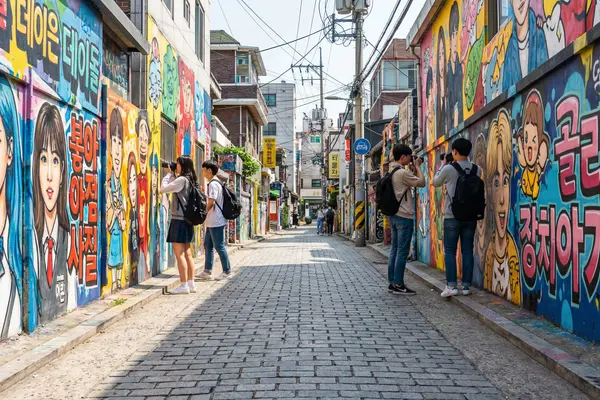
Just one or two blocks off the main strip, Hongdae changes rhythm fast. Wall surfaces become easier to read, shop entrances sit closer together, and stairs, signboards, and window edges begin to matter more than crowd density. These lanes are useful when you want to show discovery rather than spectacle.
That is why alley walls deserve their own place in a guide to the best Hongdae street photo spots. The main street is strong because of density. The alleys are strong because of spacing and layered texture. Graphic walls, older facades, narrow passages, and tighter storefront transitions give you a much more intimate version of the district.
These lanes are also useful when the main strip feels too visually loud. In the alleys, walls, stairs, sign edges, and doorways begin to take over from crowd pressure. That creates stronger opportunities for closer portrait work, detail shots, and more personal street scenes.
So the value of an alley is not simply that it is quieter. It is that it reveals a different Hongdae altogether: less public performance, more texture and discovery.
— What Time Makes Hongdae Photo Spots Work Best
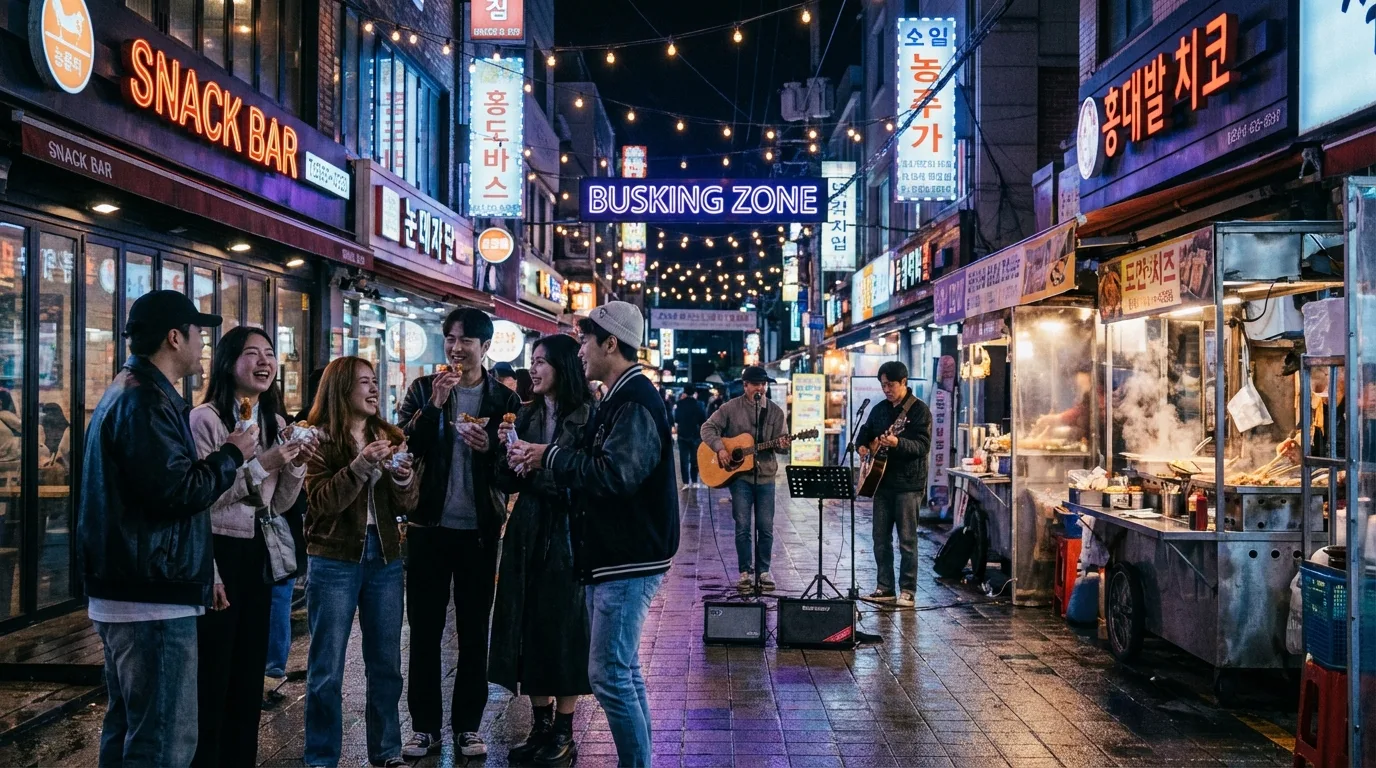
Daylight is better for reading structure, while evening is better for reading charge. If your goal is storefront detail, mural surfaces, or alley geometry, late afternoon typically gives you the cleanest result. If your goal is the pressure of the district itself, Hongdae becomes more persuasive after dark when crowd flow and mixed lighting push the frame harder.
Night also demands more discipline. Sign colors, window glow, and skin tone can fight each other quickly, so it helps to decide what the light anchor in the frame will be before you shoot. During the day, the problem is typically the opposite: the district can look too empty unless you wait for a moderate but readable level of movement.
You do not always need full darkness for Hongdae to work. The period when some blue tone remains in the sky can be especially useful because alley structure and sign light still coexist. Later hours may feel louder, but they can also flatten into pure glow if the street geometry disappears.
During the day, completely empty frames frequently weaken the district. Hongdae typically looks better with readable motion than with total stillness.
— A First-Time Route for Photographing Hongdae Well
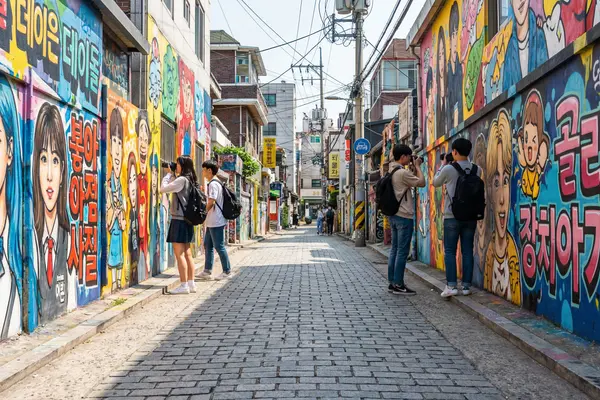
For a first visit, the simplest route is to start on the main street, pass through a busking zone, and then peel into a narrower alley. That sequence lets the district move from public energy into smaller, more personal textures. The strongest results typically come from watching those transitions instead of staying fixed in one popular corner.
It also turns Hongdae Seoul Neighborhood Guide into something visible on the ground. The guide explains Hongdae as a district of speed and overlap, and this route lets you verify that idea frame by frame. Later sub-guides on cafes or style contrast will make more sense once you have already seen how the street itself behaves.
In practice, this route is strongest when you keep moving rather than defending one popular spot for too long. Main strip, busking area, alley, and return flow each reveal a different layer of Hongdae. Even short stops in each zone frequently produce a better set than one long stop in only one area.
The route also adapts well to different kinds of visits. Solo visitors frequently benefit from using the main street to understand rhythm and the alleys to secure steadier compositions. Pairs or groups can use the transitions themselves as part of the story.
— What simple rules make Hongdae street photos more reliable
The most useful rule is to watch density change instead of chasing emptiness. Hongdae frequently looks weak when it is too empty and unreadable when it is too crowded. The ideal frame typically keeps one or two anchors visible while still preserving enough movement to feel alive. On the main strip, those anchors may be a sign axis or queue line. In busking zones, they may be the audience direction. In alleys, they are frequently the wall edge or lane line.
Weekdays and weekends are useful for different reasons. Weekdays make the district's structure easier to study. Weekends make its energy easier to feel. Neither is automatically better. The real question is whether you want your Hongdae image to feel crowd-driven or texture-driven. Once that is clear, choosing the right zone becomes much easier.
The main strip is strongest when you frame overlap between signs, queues, and crossing foot traffic.
Busking zones feel most like Hongdae when the image includes both performance and crowd reaction.
A main-street to alley sequence gives the clearest read on both Hongdae's public energy and its tighter textures.