EDITORIAL CHECK
Source and Review Basis
Hongdae guides are checked against Seoul tourism and city street references for Red Road, walking flow, performances, nightlife, and time-of-day differences.
A Hongdae Seoul neighborhood guide often focuses on broad ideas of youth culture, but on the ground, Hongdae is a dense network of concrete experiences. This is the district where an 8,000 KRW vintage shirt hangs next to a packed 24-hour pork soup restaurant, and where a 3-minute walk off the main strip drops you into a silent residential alley. This guide breaks down exactly what you will see, where to walk, and how to navigate the physical space of Seoul's busiest university district.
What Should You Expect on the Ground in Hongdae?
- How to get there: Take Subway Line 2, AREX, or Gyeongui-Jungang Line to Hongik University Station. Exit 9 dumps you right into the main commercial crowd. Use Exit 3 (Yeonnam-dong side) for cafes and quieter parks, or Exit 8 for direct access to the street fashion alleys.
- Recommended time to visit: 3:00 PM to 5:00 PM for cafe hopping and shopping without shoulder-to-shoulder traffic. 7:00 PM to 10:00 PM for peak busking energy and neon street scenes.
- Estimated duration: 3 to 4 hours is enough to cover the main pedestrian street (Eoulmadang-ro), grab street food, and sit down at a cafe.
- Crowding & Precautions: Fridays and Saturdays after 6:00 PM near Exit 9 become severely crowded. It can easily take 10 minutes to walk a 100-meter stretch. Stay on the outer edges if you dislike tight crowds.
If you step out of Exit 9 at exactly 3:00 PM, the sunlight hits the pavement sharply, highlighting the rows of cosmetic shop windows and the 4,000 KRW tanghulu stands. By 7:30 PM, this exact spot is completely transformed by intersecting LED signs, overlapping bass loops from competing clothing stores, and dense queues for photobooths. Hongdae does not have massive palaces or grand museums. Its main attraction is the sheer volume of shops, food carts, and people crammed into a 1.5-kilometer radius.
Why Did Hongdae Grow Beyond a Campus Hub?
Hongdae (short for Hongik University) originally grew around the art students of the nearby campus. Today, the art school influence is visible in the physical layout: dozens of narrow, winding alleys extending outward from the main artery of Eoulmadang-ro. Rather than large department stores, Hongdae is filled with 15-square-meter independent boutiques and second-floor indie music venues holding 50 to 100 people.
The architecture reflects this density. You will see three different businesses stacked vertically in a single narrow building: a 5,000 KRW ramen shop in the basement, a silver jewelry kiosk on the ground floor, and a specialty drip coffee shop on the second floor. This physical layering means that exploring Hongdae requires looking up and walking up steep staircases, rather than just scanning ground-level storefronts.
What Are the Real Drawcards for Visitors Today?
People go to Hongdae for immediate gratification and rapid turnover. The typical visitor's route might involve grabbing a 2,500 KRW twisted donut (kkwabaegi) from a street window, spending 20 minutes in an automated photobooth with props, and then browsing a rack of 15,000 KRW oversized t-shirts—all within a single 50-meter block.
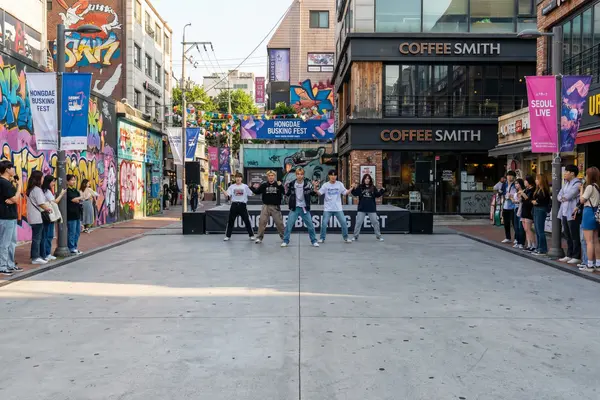
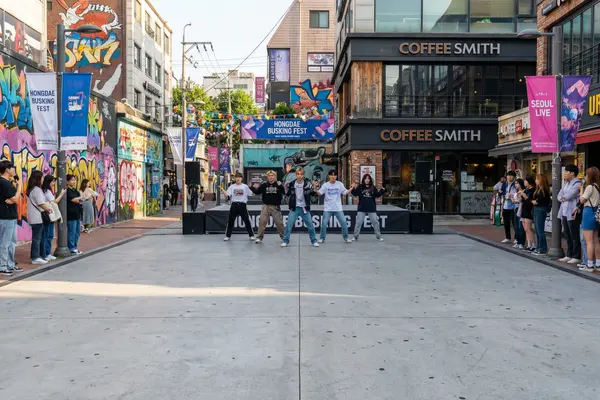
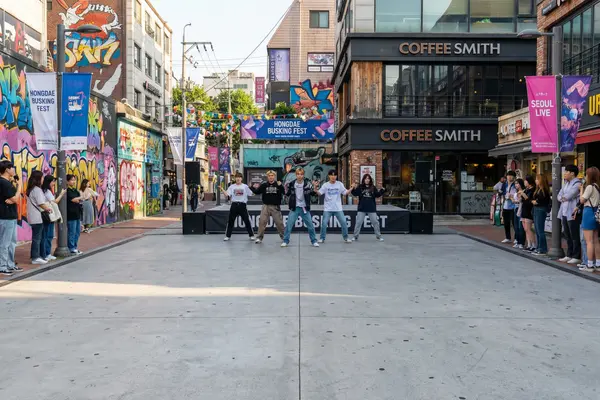
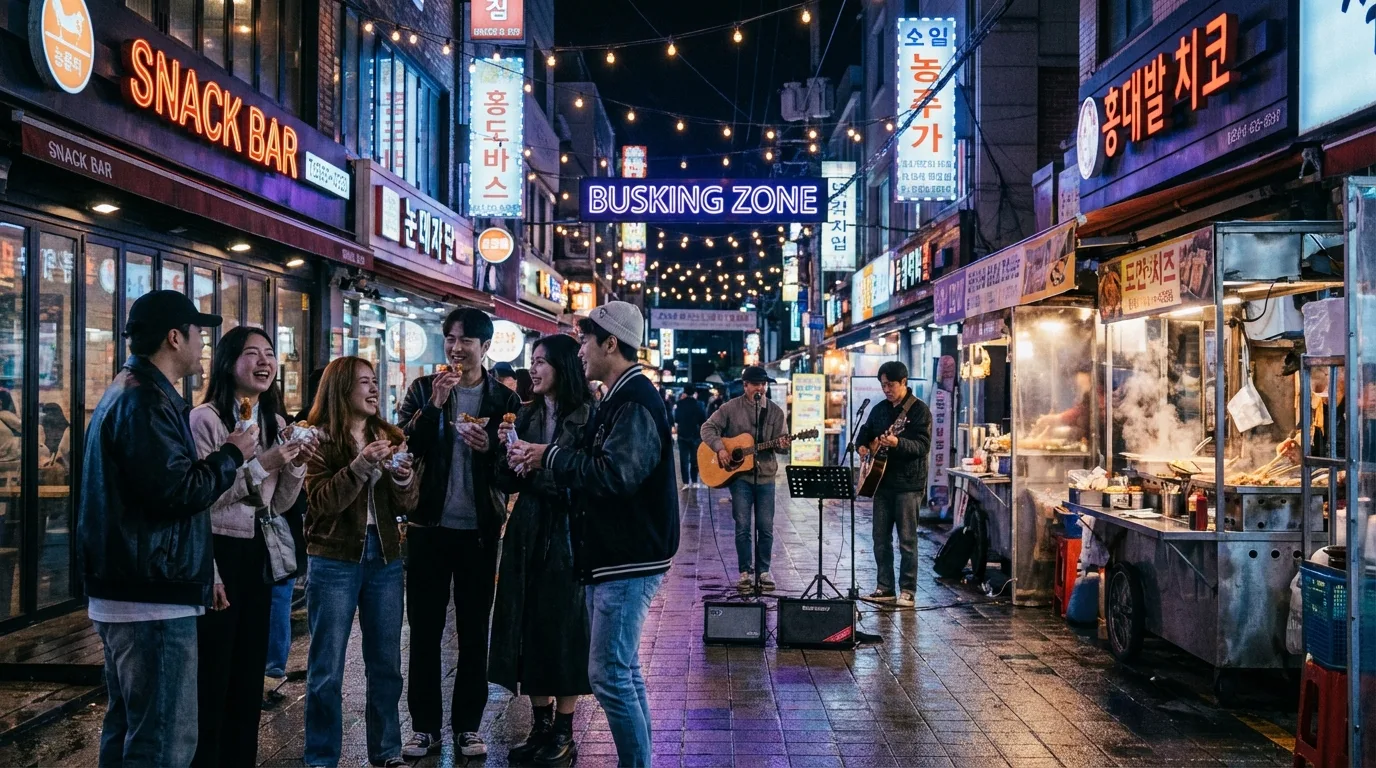
The busking zone along the Red Road is another massive draw. Between 6:00 PM and 10:00 PM on weekends, you will find 10 to 15 different street performers spaced roughly 20 meters apart. You will hear a live acoustic guitar act completely overpowered by a 7-member K-pop dance cover crew right next to them. The crowd naturally forms tight semi-circles around the performers, turning the middle of the street into a shifting obstacle course.
Navigating the Day-to-Night Contrast
If you arrive at 11:00 AM, Hongdae is almost asleep. Delivery trucks block the narrow roads, shutters are down, and cafe owners are just sweeping the front steps. The district truly wakes up around 2:00 PM.
By 9:00 PM, the lighting pressure is intense. Neon signs from 24-hour PC bangs, glowing menus for all-you-can-eat barbecue joints, and the bright white LEDs of 24-hour convenience stores flood the streets. The gap between day and night here is measured in decibels and foot traffic. A side street that takes 30 seconds to walk down at 2:00 PM will take 4 minutes to navigate at 9:00 PM.
How Does Hongdae Compare to Seongsu or Gangnam?
Unlike the wide, grid-like avenues of Gangnam, Hongdae is famously chaotic. Gangnam directs you in straight lines; Hongdae forces you to zigzag. Seongsu-dong is known for massive, beautifully designed pop-up stores in converted warehouses. Hongdae, conversely, is about micro-retail.
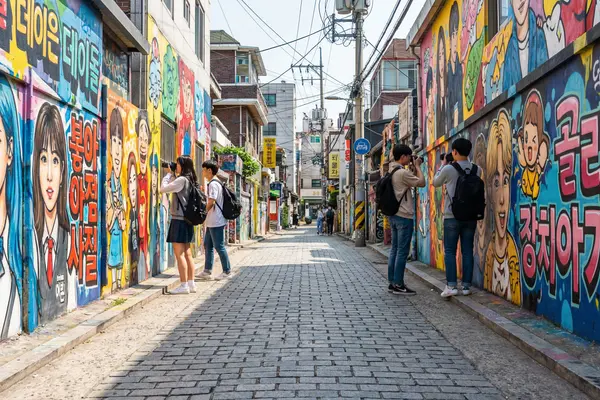
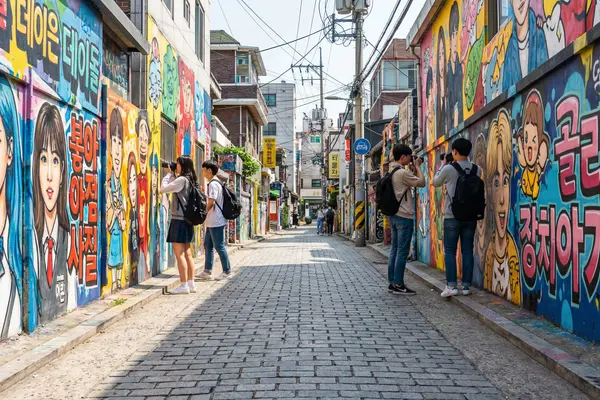
Where Seongsu feels curated and deliberate, with visitors stopping to photograph a single minimalist brick wall, Hongdae feels messy and instantaneous. You might step over a puddle from a street cleaner's hose, dodge a speeding delivery scooter, and accidentally find a hidden vintage basement shop all in the span of one minute. The visual texture of Hongdae is built on this friction—flyers taped over older flyers, utility poles covered in stickers, and menus spilling out onto the sidewalk.
The Physical Reality of Walking Hongdae
Walking Hongdae is an active physical task. The sidewalks are uneven, and in the central pedestrian zones, you share the asphalt with electric scooters and slow-moving delivery bikes. When photographing the area, the best shots rarely come from standing perfectly still. The best images capture the blur of a passing taxi against a stationary crowd waiting for spicy rice cakes (tteokbokki), or the sharp contrast between a dark brick wall and a blazing 50-inch digital menu board.
The most efficient way to use this hub is to understand Hongdae's ground-level layout here, and then move into the narrower sub-guides based on interest. For street scenes and busking-adjacent visuals, continue to Best Hongdae Street Photo Spots From Buskers to Alleys. For interior mood, use Hongdae Aesthetic Cafes for Photos That Actually Frame Well. For a district contrast with Seongsu, read Hongdae vs Seongsu Street Fashion and Why They Read Differently.
Hongdae is a dense, high-friction district best accessed via Subway Line 2, Exit 9 for main street energy or Exit 3 for cafe culture.
The area thrives on micro-retail and layered architecture, packing food, fashion, and music into tightly compressed physical spaces.
Expect significant crowding and noise, especially after 6:00 PM, when the district transforms with intense lighting and overlapping street performances.