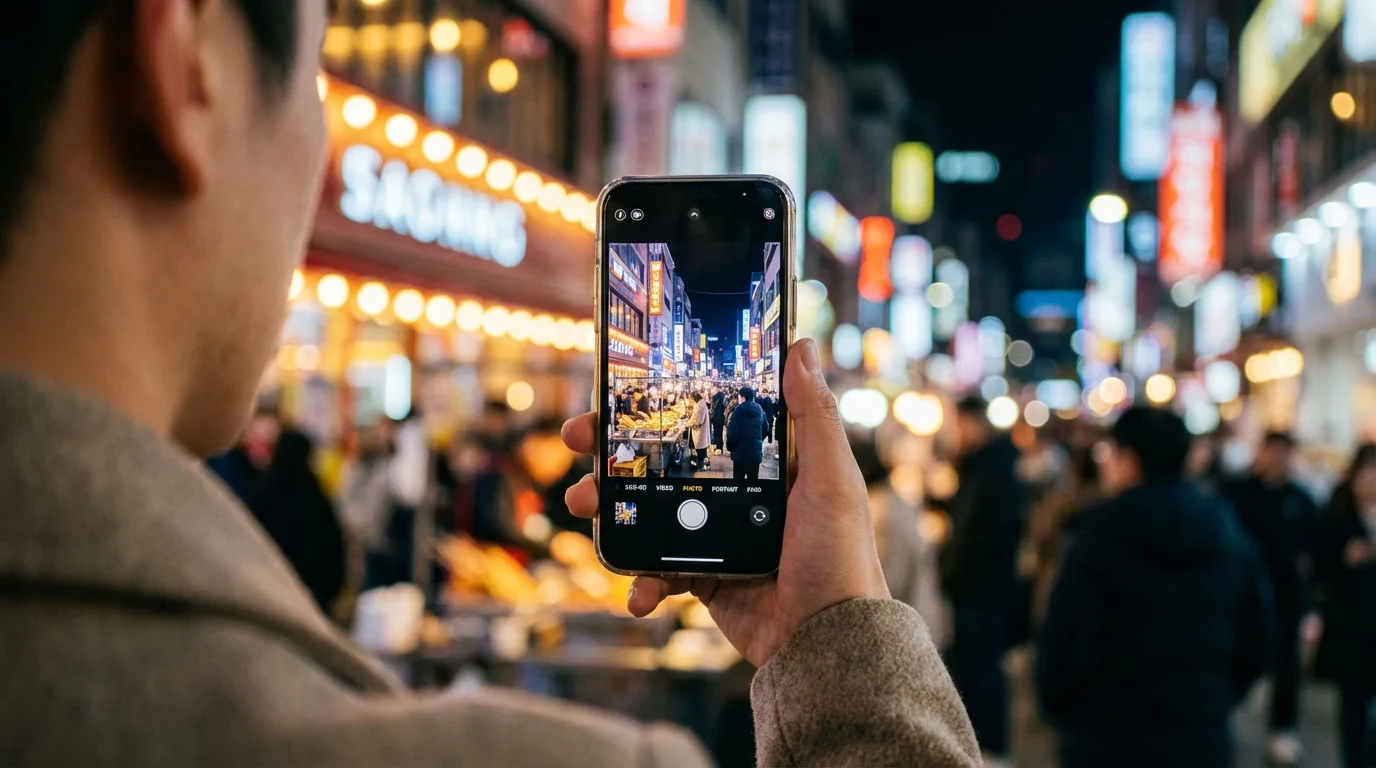
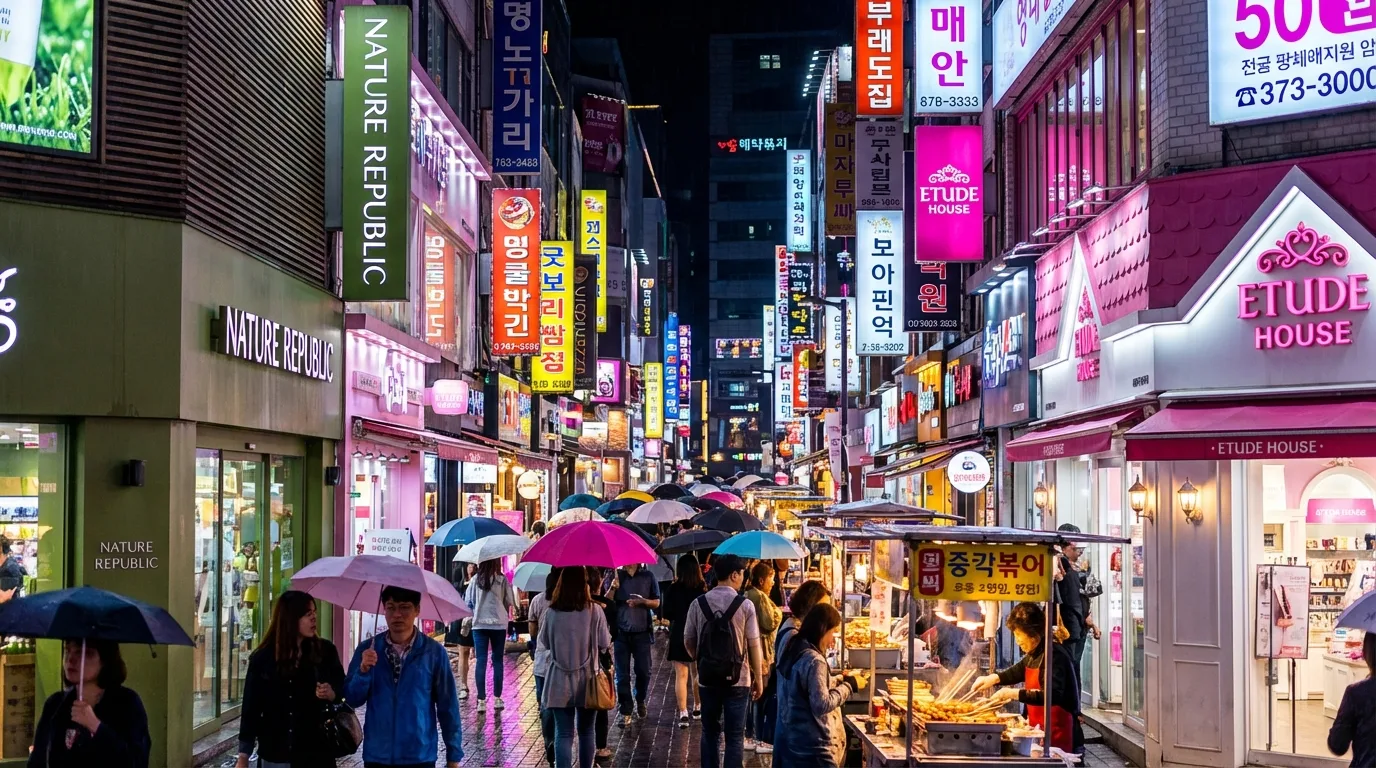
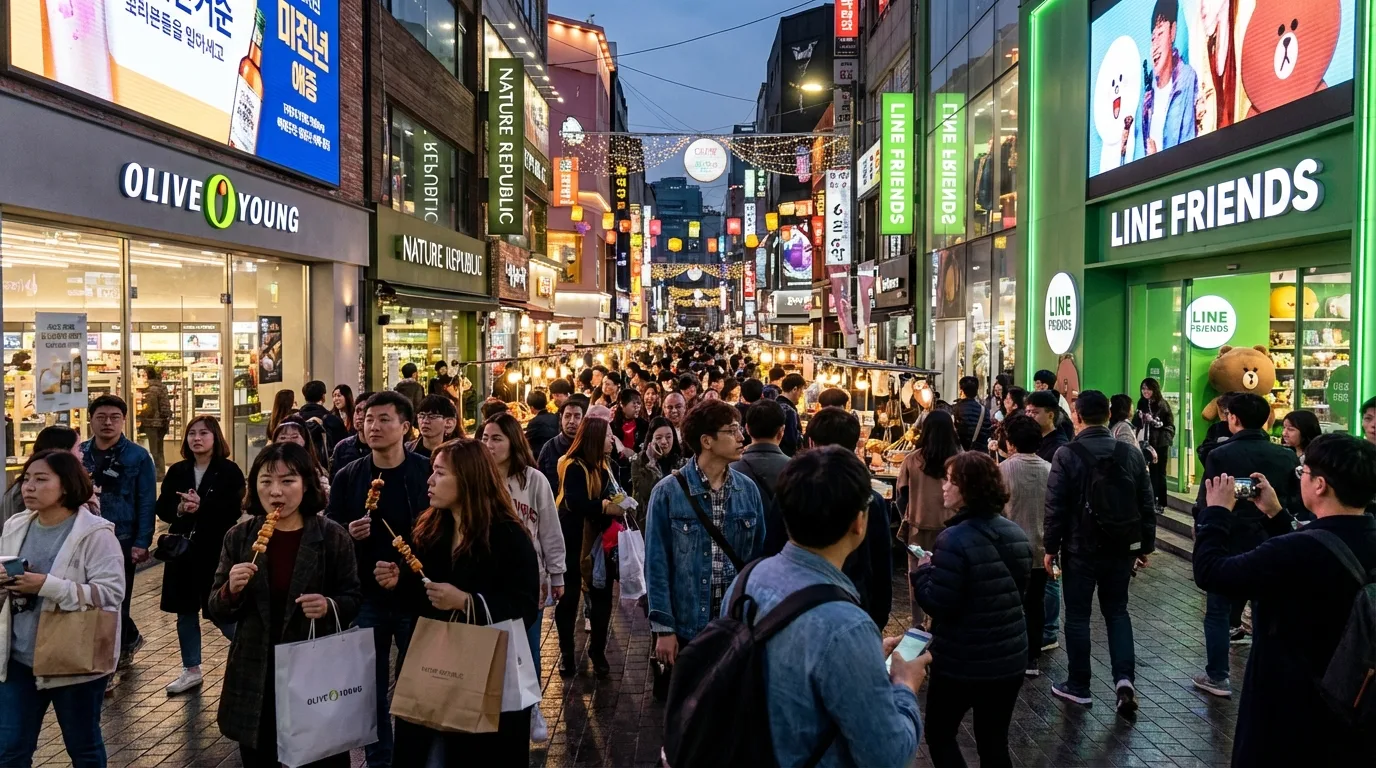
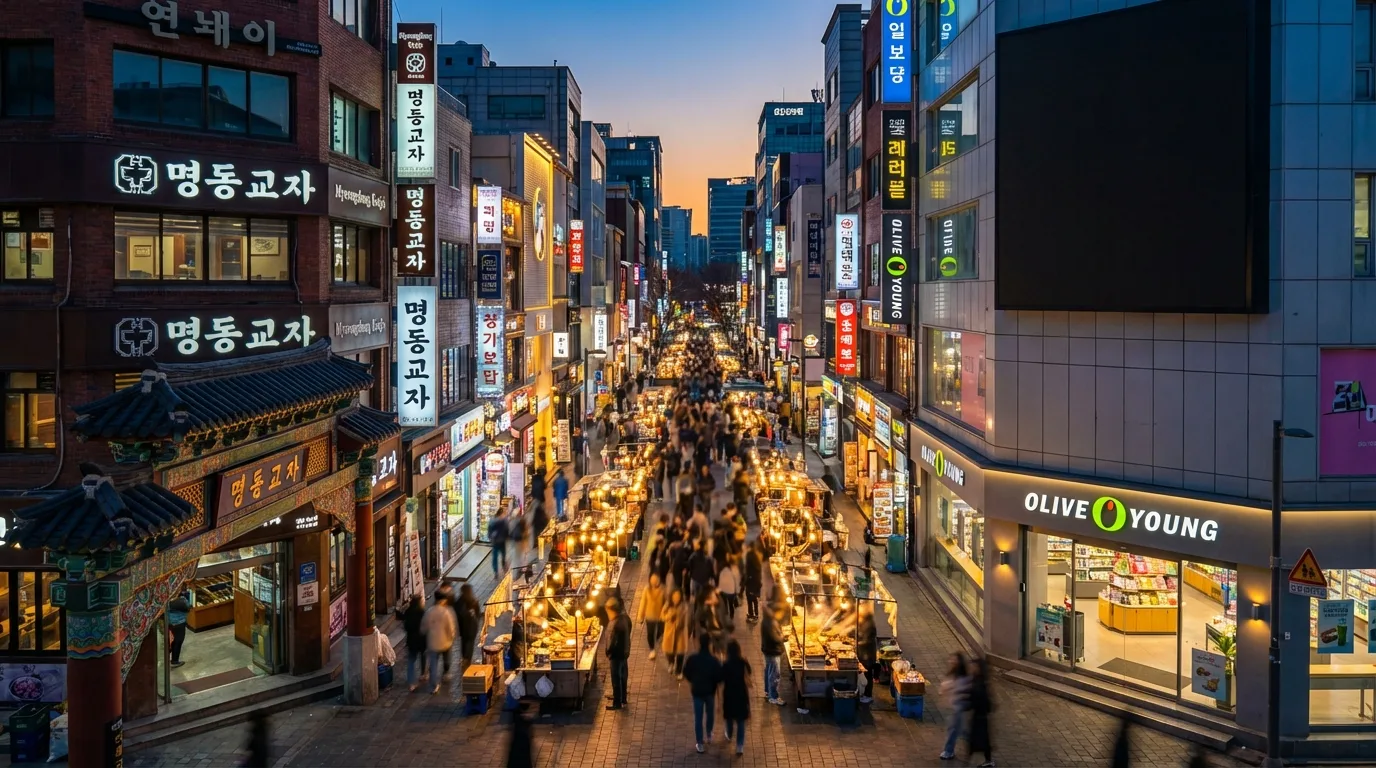
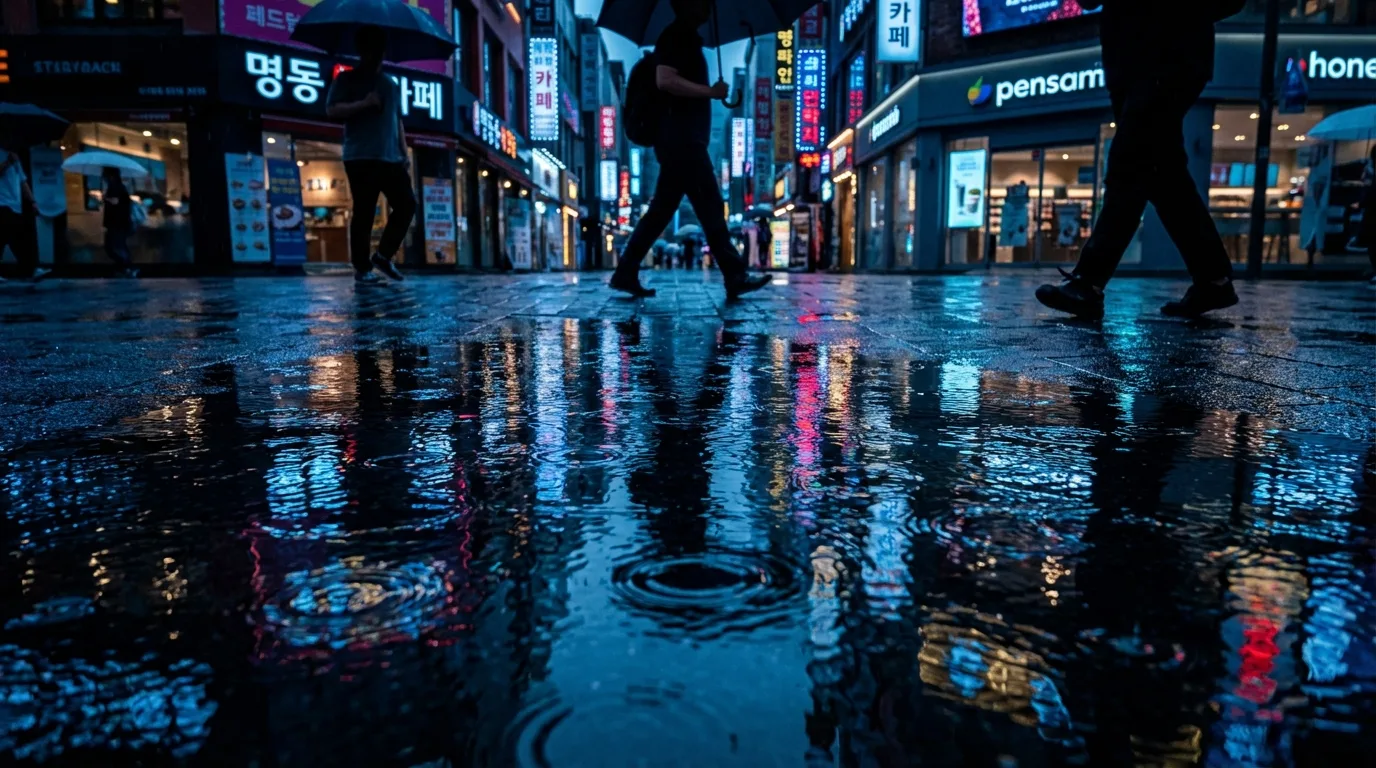
People searching for Myeongdong neon street photography usually want more than colorful signs. They want to know when the streets look best, where to start without wasting time, and whether rain reflections really improve the scene. Myeongdong works because signs, storefront light, foot traffic, and narrow lanes compress central Seoul into a very readable night frame. This guide breaks down the best hours, easiest starting points, reflective pavement logic, and a simple first-time shooting order.
— Where should you start if you want easier Myeongdong night photos
- Best timing: early evening into full darkness usually gives the most stable mix of sky tone and sign brightness.
- Best starting points: side-street entrances and small intersections usually read more like Myeongdong than the widest road alone.
- Best rain condition: after light rain, reflections on the pavement often matter more than one sign by itself.
- Read with: start from Myeongdong Travel Guide — Shopping Food Night Route, then use Myeongdong K-Beauty Shopping Guide — Fast Comparison Route if you want to connect retail and photography in one evening.
For a first visit, it helps to start where signs sit closer to the walking lane. Myeongdong looks strongest when the frame feels compressed, not when the street opens too widely.
That is why side-street entries and tighter intersections often outperform the broadest avenue. They show overlap, crowd rhythm, and commercial density faster.
For first-time visitors, it often helps to arrive from the Myeongdong Station side, read the main pedestrian flow quickly, and then stop chasing the broadest road. Myeongdong works less like a skyline view and more like a compressed commercial corridor. The tighter entry points usually explain that identity much faster.
It is also not always helpful to search for the darkest or quietest lane. Myeongdong looks strongest when movement, sign light, and storefront use all remain visible together. Very empty alleys can lose the district's specific energy.
— Why does Myeongdong read more directly than other Seoul night streets
Myeongdong's light is tied to active use. People are shopping, eating, moving, and comparing things at the same time, so the scene feels functional as well as bright.
That makes the district easier to photograph than some mood-led neighborhoods. Instead of waiting for one stylized moment, you can build the image from repeated layers of storefronts, silhouettes, and reflected light.
This is one reason Myeongdong reads differently from places such as Euljiro or Hongdae. Euljiro often depends more on texture and older sign layers. Hongdae often depends more on youth energy and shifting crowd behavior. Myeongdong is more immediate. The signs feel less decorative and more like proof that the district is actively working.
— What shooting order works best for first-time visitors
The simplest order is to start in one bright corridor where people move toward you, then shift into a narrower lane where signs stack above eye level. The first gives you motion and crowd rhythm. The second gives you the compressed commercial frame most people associate with Myeongdong at night.
Walking farther is not always better here. Repeating two or three strong sections often teaches the district faster than covering every block once.
For beginners, it often helps to narrow the first route into just three scene types: one brighter corridor with people moving toward you, one tighter sign-heavy lane, and one small intersection where light and movement cross. Those three scenes usually explain most of what Myeongdong does at night.
It also helps not to point the frame too high all the time. If the shot becomes only signs, the district can lose the human scale that makes it feel recognizably Myeongdong. Shoulder-height framing that keeps both movement and signage often works better.
If you want to turn that Seoul night-beauty mood into something usable right away, trying a K-style beauty profile is a natural bridge after the photo route.
— How do rain and reflective pavement change the look
After rain, the ground becomes part of the subject. Light stretches down from storefronts and signs onto the pavement, which adds a second layer to the frame and often makes the scene feel richer than a dry night.
In those conditions, you usually get better results by leaving room for reflections and footsteps instead of filling the frame with sign detail alone. A small step back often improves the whole composition.
Rain also makes the district feel visually deeper because the light doubles itself on the ground. Umbrellas, wet shoes, and crossing movement often become more useful than one especially bright sign. At the same time, too much reflection can make the image noisy, so beginners often do better with lightly wet pavement than with one huge reflective puddle.
— Where should you stand when the district gets crowded
Myeongdong gets busy quickly in the evening, so a good night-photo spot is not only the prettiest one. It is also one where you can pause without getting pushed out immediately. Small intersection edges, slightly recessed storefront fronts, and side-street mouths often work better than standing directly in the center of the main flow.
- Standing slightly off the main pedestrian line usually makes composition easier and less stressful.
- Small intersections often work well because they hold both crossing motion and stacked signage.
- Side-street entrances are usually easier than deep interior alleys for first-time shooting.
- Fast handheld shooting often fits Myeongdong better than trying to hold one perfect static position for too long.
This is part of why Myeongdong stays such a common first Seoul night-photo district. Even under crowd pressure, the visual logic remains easier to understand than in many other neighborhoods.
— Why is Myeongdong such a common first Seoul night-photo stop
Myeongdong gives first-time visitors a readable version of Seoul at night without much explanation. Transit access is easy, the route can stay short, and food, shopping, and photography all fit into one district.
Its strength is not just brightness. It is immediacy. Visitors can arrive without much local context and still leave with a clear, energetic, unmistakably urban Seoul frame.
In practical terms, arriving around dusk, reading the main flow first, repeating a few strong lanes, and using pavement reflections when available is already enough. Myeongdong night photography usually rewards scene reading more than elaborate technique.
— How does dusk differ from later-night Myeongdong photography
Dusk usually gives the easiest first result. There is still enough sky tone to keep the frame readable, storefront light is starting to build, and crowd movement has energy without fully overwhelming the route. For many visitors, this is the point when Myeongdong feels most balanced.
Later at night, the district becomes denser, brighter, and more aggressively commercial. That can be exciting, but it also makes selection harder. The frame fills more quickly, and the photographer has to cut more decisively. That is why dusk often works better for a first visit, while later-night shooting makes more sense once the district logic already feels familiar.
— What if you want to combine photos with shopping or food
Myeongdong is useful because the night-photo route does not have to stay separate from the rest of the district. But order matters. If you start with too much shopping or too much street food, the route often becomes physically heavier and visually less flexible. The simpler approach is to read the main flow first, take the strongest compressed night frames, and only then expand into beauty shopping or snack stops.
This preserves the district's logic. Myeongdong photographs best when movement still feels free, so the camera route usually works better before the evening becomes too loaded with bags, food, or rushed decisions.
Myeongdong night photos usually work best from side-street entries and tighter intersections rather than only the widest road.
First-time visitors usually do better repeating a few strong sections than trying to cover the whole district in one sweep.
After rain, reflections on the pavement often matter more than the signs alone for building a memorable frame.