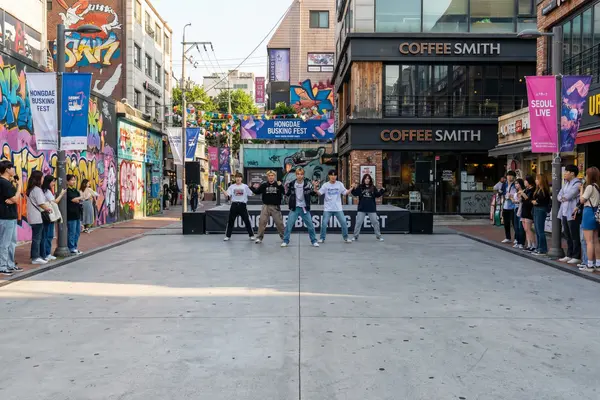
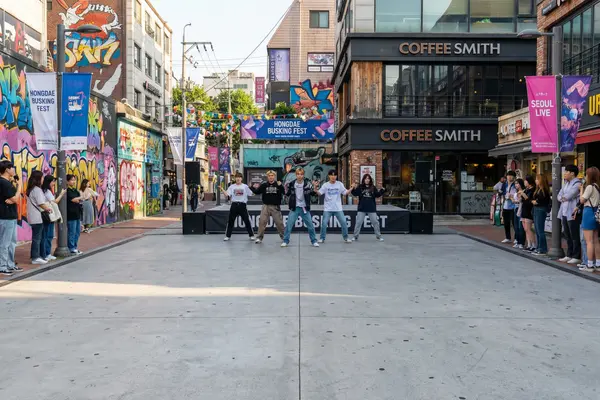
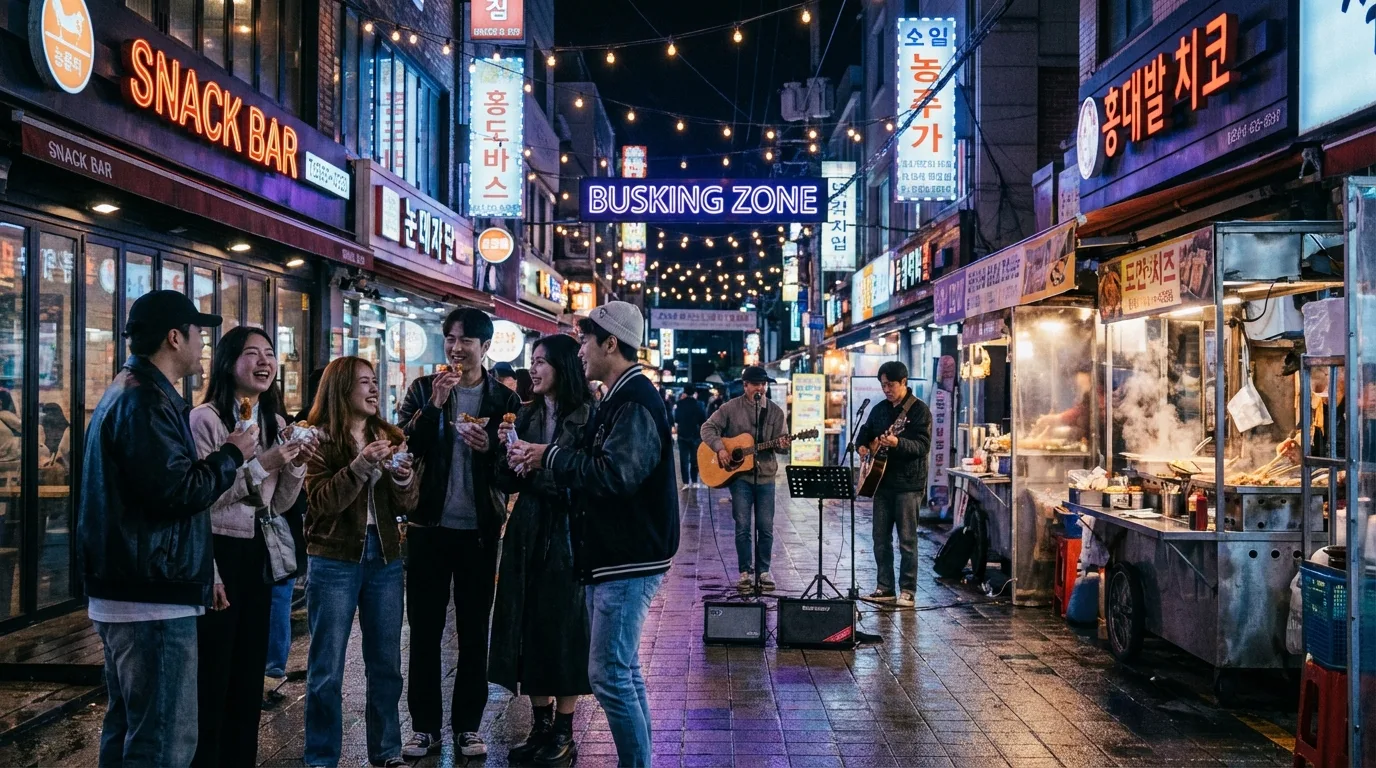
Hongdae street fashion outfit tips are useful because the district reads clothes while they are moving through crowds, signs, small shops, cafes, and street performances. Oversized outfits and graphic tees may look like the obvious answer, yet the stronger choice comes from controlling top length, shoe volume, bag placement, and how the outfit survives a walking route. This guide narrows the wider Seoul Street Fashion Trends hub into practical Hongdae styling decisions for photos, shopping, and everyday streetwear.
Start with the district before styling the outfit
- Starting route: use the walking flow around Hongik Univ. Station Exit 8-9, then move through Eoulmadang-ro, smaller fashion-store alleys, and cafe blocks where the background changes quickly.
- Best time window: weekday 2-5 p.m. is calmer for checking proportion; Friday evening and weekend 4-8 p.m. show stronger crowd rhythm and light.
- Time needed: 40-70 minutes is enough for one outfit check, while shopping plus photo stops can easily take 90 minutes or more.
- Cost logic: street observation is free, but keep a separate small budget if cafes, accessories, or quick fashion purchases are part of the route.
- Check order: top hem, bottom width, ankle break, shoe volume, graphic placement, bag strap, then handheld items.
Hongdae is not a clean studio for clothes. It is a moving field of storefronts, narrow walking lines, music, signs, and people crossing in front of each other. A look that seems strong in a mirror can disappear if every detail needs a close view.
The useful question is simple: what should be read first? If the graphic tee is the main signal, the bag strap should not cut through it. If the shoes carry the outfit, the pant hem has to show enough of them. Hongdae styling is less about adding more items and more about deciding which signal should be read first in a moving street.
Control oversized outfits by stopping the shape
Oversized outfits make sense in Hongdae because the district already contains visual pressure. A wide hoodie, boxy shirt, loose jacket, or relaxed denim does not feel empty when it sits inside crowds and signage. The risk is not size by itself. The risk is losing the place where the body line stops.
Choose one clear stopping point. A cropped or waist-length top keeps the legs visible. A top ending around the upper hip creates the safest casual balance. A longer top can work, but then the pants need a cleaner vertical fall so the lower body does not become a single heavy block.
Fabric weight matters as much as width. If the hoodie and pants both feel thick, add a lighter outer layer or a thinner inner tee. If the jacket is bulky, keep the pant surface calmer. The street can handle volume, but it becomes harder to read when every layer has the same visual weight.
A common failure is letting every line become long. Long top, long strap, long pants, and a low shoe push the outfit downward. One short break fixes more than people expect. It may be a shorter jacket, a visible belt line, a cropped inner layer, or a shoe with enough toe shape to catch the eye.
Make graphic tees survive signs, crowds, and photos
Graphic tees fit Hongdae because the district has a fast, youthful visual rhythm. They also fail quickly when the print competes with every other detail. A small chest print can vanish in a crowd. A large center print can become messy if a crossbody bag cuts through it. Before adding accessories, decide whether the graphic is supposed to be the main frame or just a background layer.
Color should be chosen with the street in mind. Black tees need denim wash, lighter shoes, silver details, or a pale layer so the upper body does not sink into dark storefronts. White tees need darker pants, a stronger bag, or a clear outer layer so the outfit does not float under bright shop lighting.
If the tee already speaks loudly, reduce the rest. Hat, necklace, bag charm, belt detail, and heavy shoe shape do not all need to appear in one outfit. Two visible signals are enough for most Hongdae routes. More than that can make the person harder to read than the styling.
Shoes, bags, and pockets decide whether the route works
Shoes carry more responsibility in Hongdae than they do in a still photo. The route can involve stairs, narrow lanes, store entrances, crowded crossings, and standing in lines. Very thin shoes may look clean indoors but feel visually weak with wide pants or a large top. A sneaker with some sole weight, a structured loafer, or a stable boot can hold the outfit while still being practical.
Watch the ankle break. If the pant covers too much of a low shoe, the hem looks tired. If the pant is cropped and the sock creates a sharp extra band, the leg line becomes too segmented. The easiest check is whether the shoe can still be recognized while walking.
Bags need the same test. A large tote helps with shopping but may pull one shoulder down. A small crossbody keeps hands free but can break a graphic tee in the wrong place. A compact shoulder bag, nylon sling, short-strap mini bag, or close-to-body pouch tends to move better through Hongdae.
If the wardrobe base still feels unstable, read K-Fashion Wardrobe Essentials before buying stronger trend pieces. Pants, jackets, shoes, and bags need to work first; Hongdae details become easier once those four pieces already hold the outfit.
Timing changes the same Hongdae style vibe
| Timing | Street condition | Outfit decision | |---|---|---| | Weekday 2-5 p.m. | Storefronts and cafes are easier to see | Check top length and pant shape first | | Friday evening | Signs, crowds, and sound rise together | Use stronger contrast such as black, washed blue, red, or metallic detail | | Weekend afternoon | Shopping and photo routes overlap | Keep bag placement and shoe comfort practical | | Rainy day | Reflections and umbrellas divide the frame | Avoid dragging hems and use one weather-ready material | | Seasonal transition | Day and evening temperatures split | Carry a light outer layer and keep the inner layer simple |
The same outfit can look different after the street changes. Daytime shows proportion more clearly. Evening adds color pressure from signs and storefront light. Weekends make the background busier, so adding more color is not always the answer. A single clear point can read better than three loud ones.
Choose the outfit by purpose, not by trend label
For photos, start near the face and upper body. Decide whether the strongest point is the graphic, jacket shoulder, collar, necklace, or color near the face. Then set the pants and shoes. Bag placement comes after that, because a strap can easily interrupt the point you wanted to show.
For shopping, simplify the outfit. A thin inner layer, pants that are easy to compare against new tops, shoes that come off without effort, and one visible style point will make fitting-room decisions faster. If the base outfit is already complicated, every new item becomes harder to judge.
For a same-day district comparison, use Hongdae vs Seongsu Street Fashion before deciding the route. Hongdae tests whether the outfit can hold energy inside a moving background. Seongsu checks whether the same outfit still looks clear against calmer surfaces.
If style families still feel too close together, the K-Fashion Style Types guide separates Y2K, girl crush, high teen, fairycore, and techwear by silhouette and detail. Hongdae does not require memorizing every label. It asks whether the chosen mood can be understood quickly in a real street.
Hongdae styling starts with the first visible signal: top hem, shoe volume, graphic placement, or bag strap.
Oversized outfits need a clear stopping point, while graphic tees need enough space to survive signs, crowds, and photos.
Photo outfits should start from the upper-body focal point; shopping outfits should start from comfort, movement, and easy comparison.