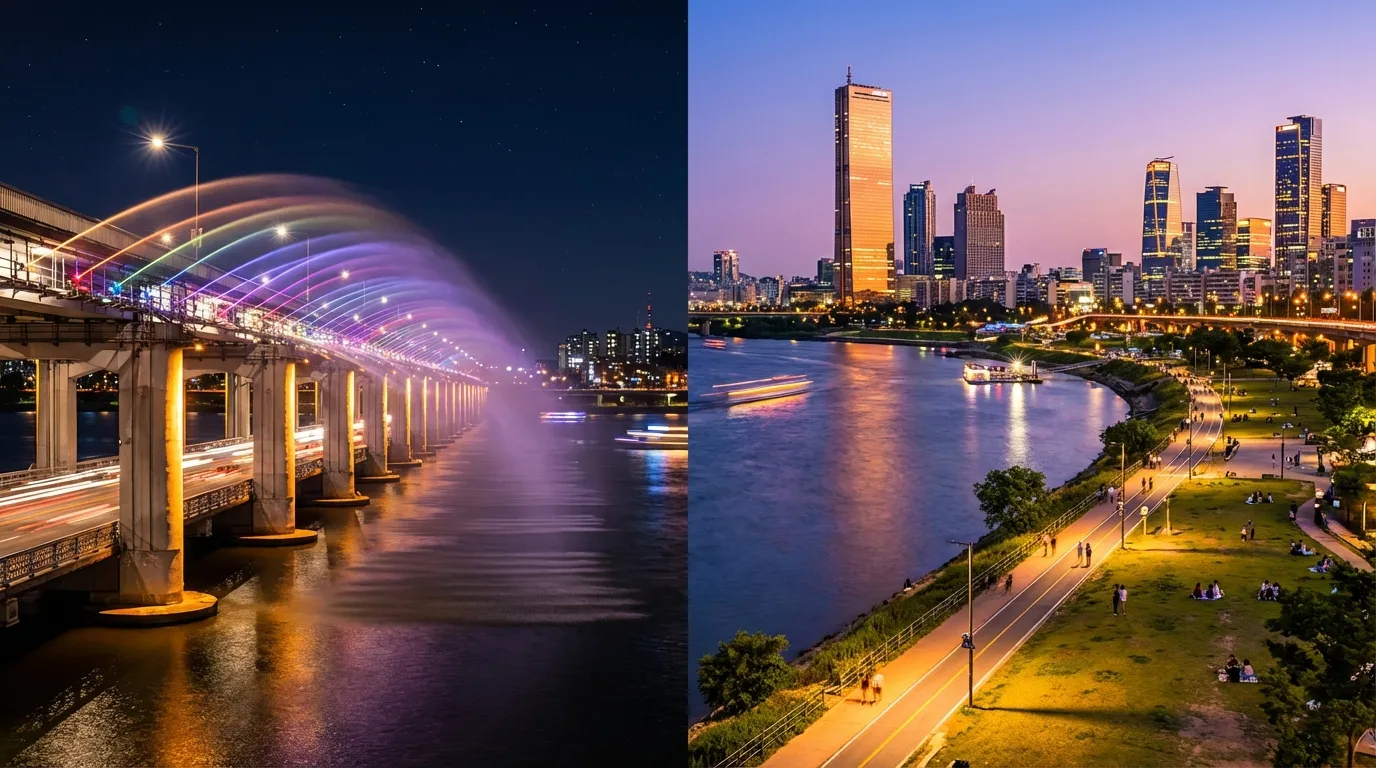
People searching for the best Han River night photo spots usually need more than a list of famous bridges. They want to know where reflections hold best, whether dusk or full darkness works better, and which riverside section gives a first-time visitor the clearest Seoul night result. Han River night photos can look similar from a distance, but in practice bridge lighting, water direction, walkway structure, and background brightness change the frame a lot. This guide builds on the wider route in Best Things to Do at Han River Park — Picnic and Night View and explains where the river photographs best after sunset.
— Where should you start if you want easier Han River night photos
💡 Han River Night Photo Spots Fact Check (Verified Oct 2026)
※ Verified on: 2026-10-11. Transit schedules, fountain operation, and parking fees are subject to change based on weather conditions and operating authority policies.
| Category | Verified Details (Seoul Future Hangang Project Headquarters) | Official Source | |:---|:---|:---| | Banpo Hangang Park Access | Express Bus Terminal Station (Lines 3/7/9) Exits 8-1 & 8-2 (approx. 15-min walk), Sinbanpo Station (Line 9) Exit 1 (approx. 15-min walk) | Directions | | Banpo Moonlight Rainbow Fountain | Low season (Mar 15–May, Oct): 12:00, 19:30, 20:00, 20:30, 21:00 (20 min per show) / Peak season (Jun–Sep): 21:30 added (suspended during rain) | Fountain Guide | | Yeouido Hangang Park Access | Yeouinaru Station (Line 5) Exits 2 & 3 (approx. 1-min walk) | Directions | | Hangang Park Parking Fees | First 30 min 1,000 KRW / 200 KRW per 10 min thereafter / Daily max 10,000 KRW (Free on Seollal & Chuseok holidays) | Parking Info |
- Best starting area: Banpo is usually easier first because bridge structure, lights, and riverside lines read clearly together.
- Best timing: the shift from dusk into early night often works better than waiting until the sky turns fully black.
- Best for: visitors who want Seoul river reflections, date-route photos, and cleaner bridge-night compositions.
- Main rule: judge the water first, not only the lights.
Bright light alone does not guarantee a better Han River night photo. When the scene is too intense, reflections can break apart and the frame can turn into scattered points of brightness instead of one readable structure.
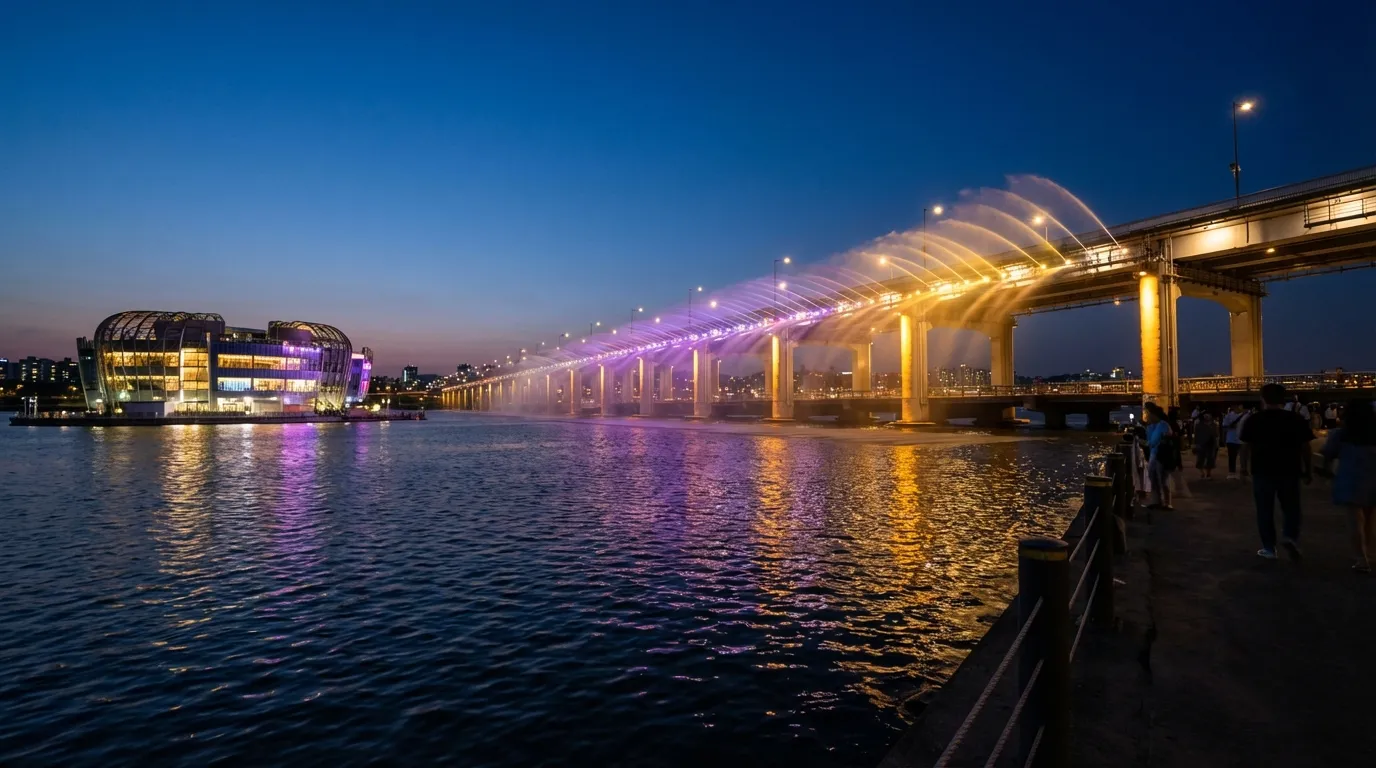
That is why first-time visitors usually get better results in sections where bridge form, walkway flow, and reflective water appear together. Around Banpo Bridge Rainbow Fountain and Some Sevit, those three elements align quickly enough to make the river feel like a composed Seoul night scene rather than a random dark view.
— What matters more here, bridge lights or water reflections
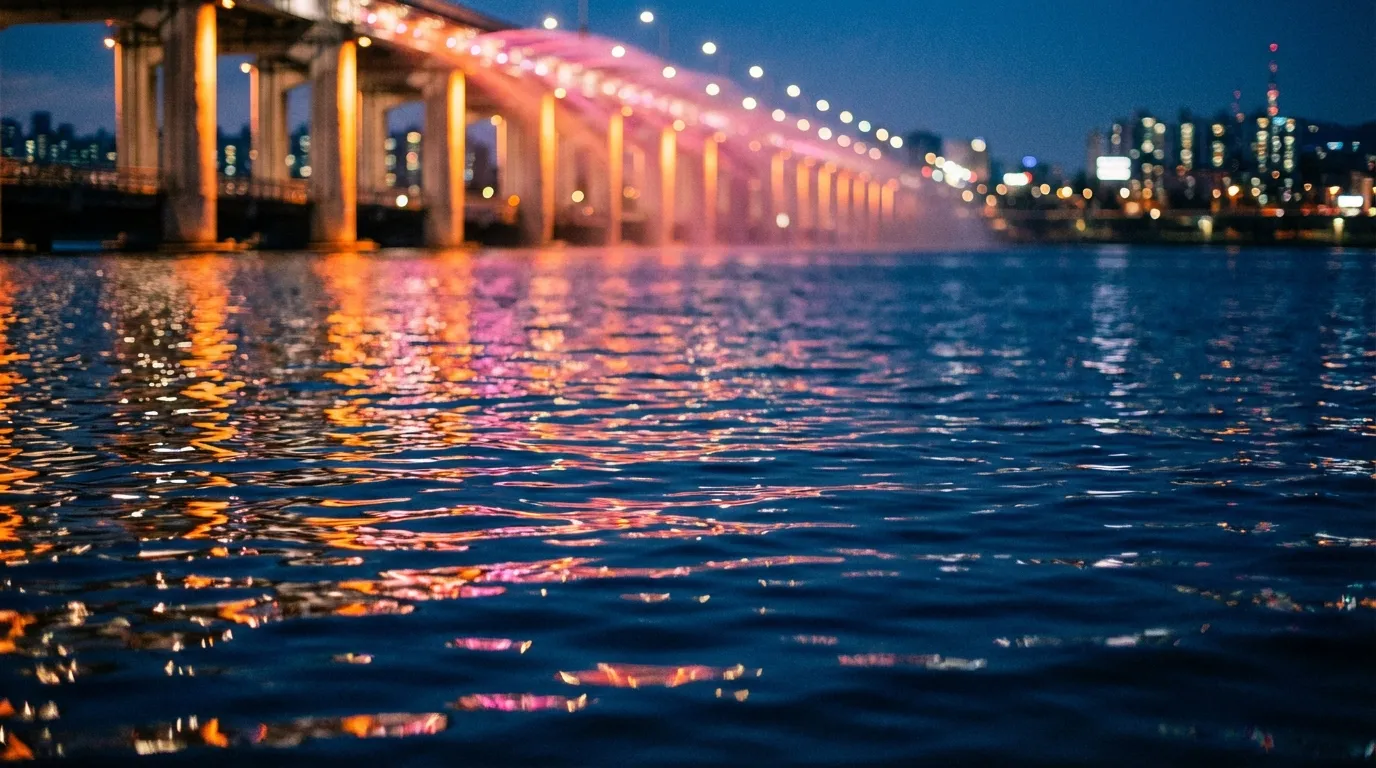
Bridge lights attract attention first, but reflections are what usually complete the image. A bridge may look dramatic in person, yet the photo can still feel weak if the water does not carry the light in a clear direction.
By contrast, when reflection lines stay long and readable, the scene gains depth even if the bridge itself is not filling the whole frame. That is why small angle changes often matter more than moving to a completely different photo point.
— Does dusk or full darkness work better for Han River night shots
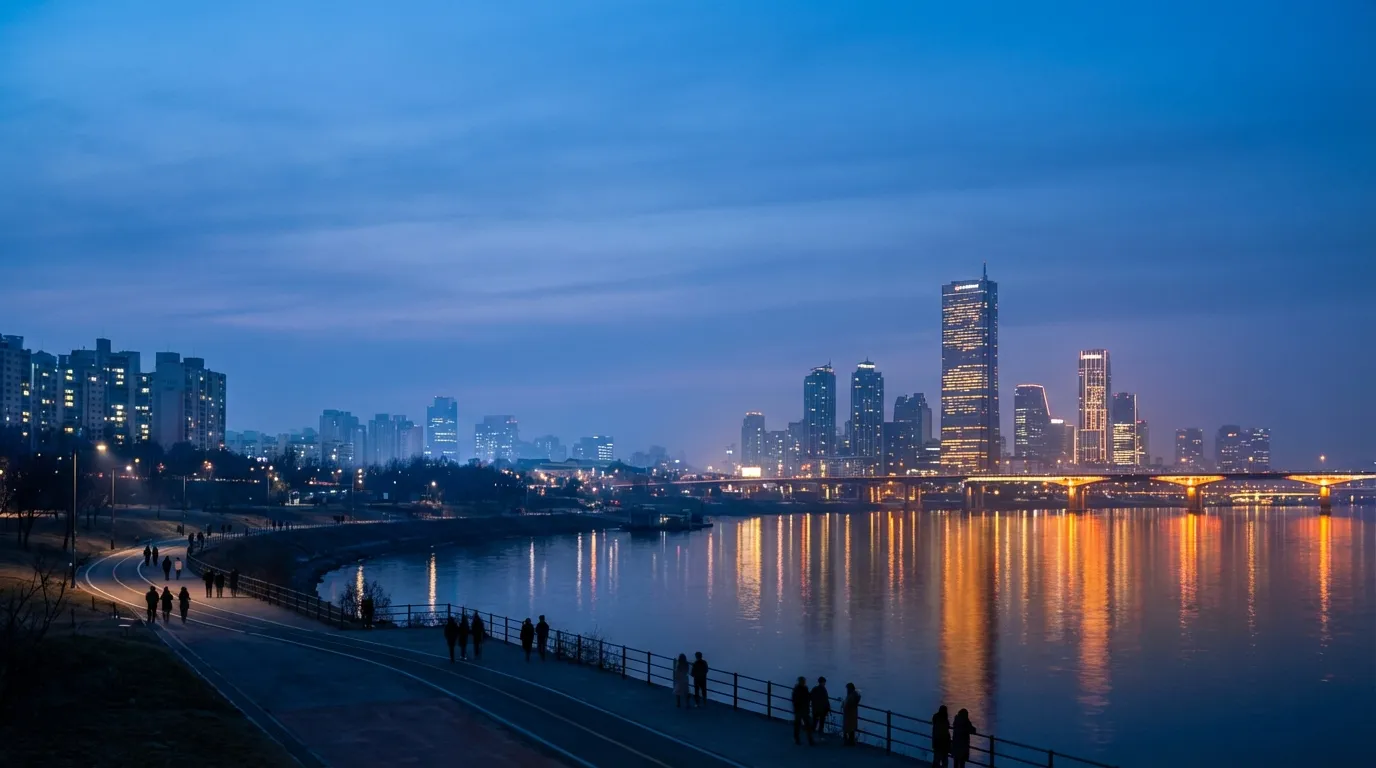
Dusk is usually more forgiving because the sky still holds some tone. That extra separation helps the river, the bridge, and the city edge stay readable in one frame, which is especially useful for first-time night photographers.
Full darkness can create stronger contrast, but it can also flatten the scene. If only the brightest lights survive, the river may stop feeling like a place and start feeling like a strip of isolated highlights.
If you want to turn that softer riverside night mood into something more directly usable, trying a K-style beauty profile is a natural bridge after the walk itself.
— Which works better for night photo spots, Banpo or Yeouido
Banpo is stronger when you want structured night photos. Banpo Bridge Rainbow Fountain, Some Sevit, water reflections, and the surrounding walkway tend to build one clearer visual argument, so it answers the search intent behind Han River night photos very quickly.
Yeouido works differently. Around Yeouinaru Station Exit 2/3 and the I SEOUL U spot, its strength is not the same concentrated bridge effect, but a wider balance of open river space and city light. That makes it better for visitors who want broader Seoul night atmosphere rather than a tighter reflection-focused frame.
In practice, Banpo is often the better first lesson and Yeouido is the better expansion. Learn the structured river-night logic first, then move into the more open version once your eye knows what to keep.
— What route helps first-time visitors avoid flat night photos
The easiest sequence is simple: one bridge-focused point, one reflection-focused point, and one walkway view where city lights and movement still remain in the frame. That three-part structure gives enough contrast without flooding the outing with near-identical night scenes.
Trying to collect too many photo points usually makes the river feel repetitive. Han River night photography improves less through quantity than through learning which small differences in light and reflection actually change the image.
— Why do crowd flow and wind matter almost as much as light here
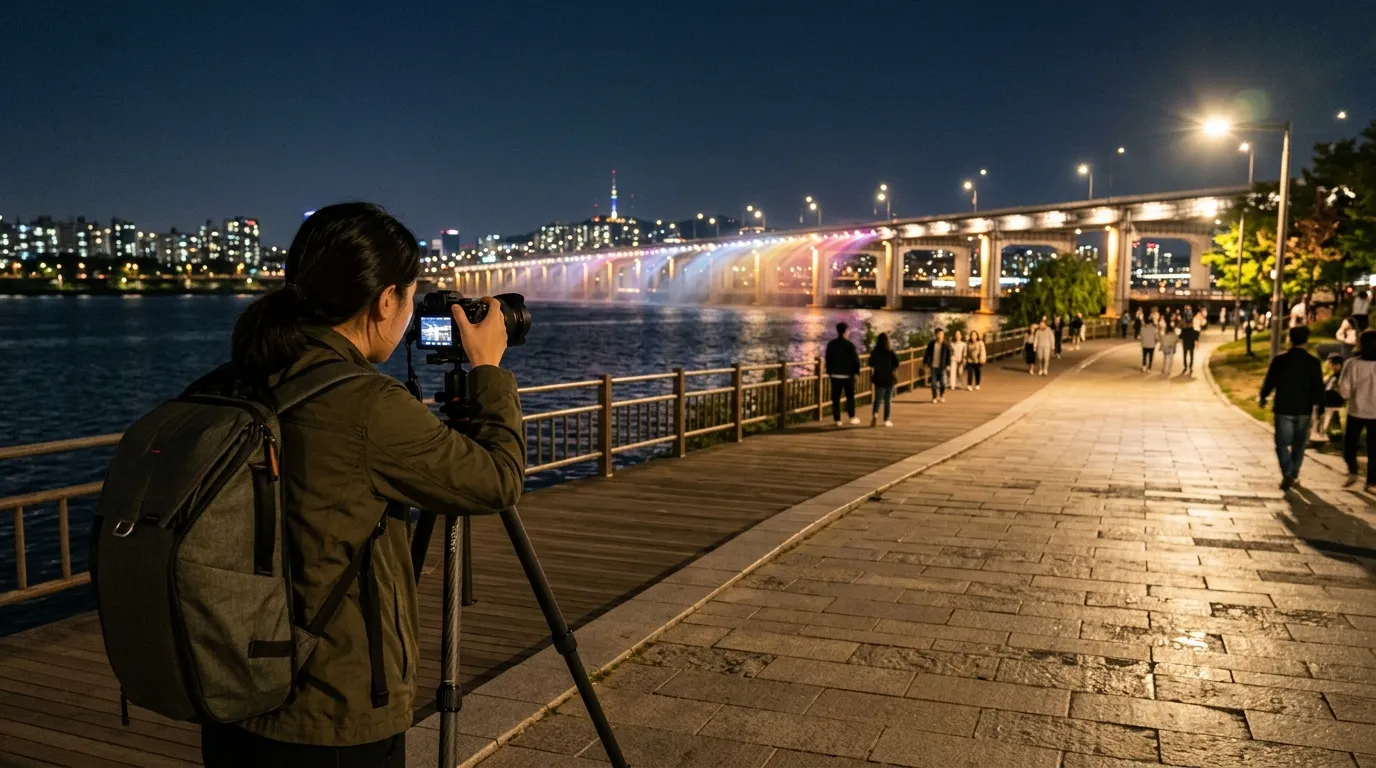
The Han River can look wide and forgiving, but crowd density and wind can change the result almost as much as the bridge itself. Busy evening points often make it harder to hold a clean angle for long, and stronger wind can break reflections so quickly that the frame loses structure. That is why first-time visitors should read the moving conditions of the site, not just its famous lights.
This is especially true around major Banpo-area viewpoints. Waiting too long for one exact famous angle is often less efficient than stepping slightly away and finding a similar bridge-and-water relationship with less interruption. The river gives enough visual continuity that small shifts can still work very well.
— What shot order helps first-time visitors avoid repeating the same image
An easy sequence is to secure one wider bridge-structure frame first, then one reflection-led frame, and then one walkway or city-edge frame where movement still stays visible. That order usually creates a more varied set even if the entire outing stays in one part of the river.
It also keeps the visit calmer. Instead of chasing only the brightest fountain or the strongest bridge lights, you begin to separate what kind of night image you are trying to make. Han River photography usually improves once the river is read as a set of scene types rather than one long strip of darkness and light.
— What should you compare first when you are not at Banpo or Yeouido
Even outside the two best-known sections, the Han River becomes easier to judge when you compare three things first: how long the light stays readable on the water, whether the walkway or railing interrupts the frame too much, and whether the background brightness helps or hurts the reflection. That logic often matters more than the district name itself.
This is why Banpo works so well as a first lesson. Its bridge form, water reflection, and pedestrian line explain the river quickly. Yeouido works once you want a wider and calmer version of the same logic. But the larger principle travels well to other parts of the Han River too.
That makes the guide more useful than a list of famous bridges alone. Once you know how to read structure, reflection, and crowd flow, you can arrive at a new riverside area and still make better decisions without relying on one exact landmark.
Han River night photos improve most when reflections stay readable, not simply when the brightest bridge lights enter the frame.
Dusk is usually easier for first-time visitors because the river, sky, and city edge remain readable before the scene turns fully contrast-heavy.
Banpo is the better first stop for structured night shots, while Yeouido works better once you want wider and calmer Seoul river frames.